As cities become denser and buildings grow taller, traditional water distribution methods are increasingly being challenged. For decades, overhead water tanks have been the standard solution for storing and distributing water in residential, commercial, and industrial buildings. However, modern developments are now shifting toward a more efficient and reliable alternative to the hydropneumatic system for water supply.
From high-rise residential towers and commercial complexes to hospitals, hotels, educational institutions, and industrial facilities, a hydropneumatic system for water supply is becoming the preferred choice due to its ability to provide consistent pressure, optimize space utilization, improve water quality, and reduce operating costs.
This article explores how a hydropneumatic water supply system works, why it is replacing conventional overhead tank systems, and what building owners, consultants, and facility managers should consider before implementation.
What Is a Hydropneumatic System for Water Supply?
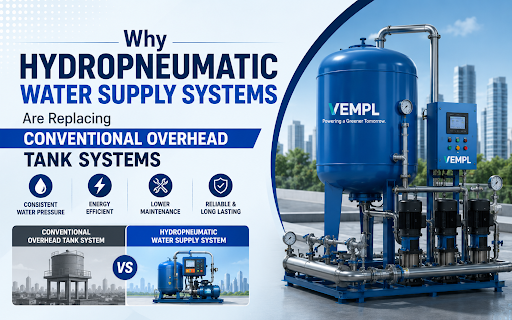
A hydropneumatic system for water supply is a pressure-boosting system that uses pumps, pressure vessels, sensors, and control panels to maintain a constant water pressure throughout a building.
Unlike traditional overhead tank systems that rely on gravity to distribute water, a hydropneumatic system delivers water directly to consumption points using controlled pressure generated by pumps and compressed air stored within a pressure vessel.
A typical hydropneumatic water supply system consists of:
- Booster pumps
- Pressure vessels
- Variable Frequency Drives (VFDs)
- Pressure sensors and transmitters
- Control panels
- Non-return valves and piping accessories
The system automatically adjusts pump operation based on water demand, ensuring a continuous and consistent water supply throughout the building.
Why Conventional Overhead Tank Systems Are Becoming Less Practical
Traditional overhead tanks have served buildings well for decades, but they come with several limitations.
Common challenges include:
- Large rooftop space requirements
- Increased structural load on buildings
- Uneven water pressure across floors
- Water stagnation and contamination risks
- Frequent cleaning and maintenance requirements
- High civil construction costs
As urban real estate becomes more expensive and building designs become more sophisticated, developers are seeking alternatives that improve efficiency while maximizing usable space.
This is where a hydropneumatic system for water supply offers a significant advantage.
1. Better Space Utilization
One of the biggest reasons developers prefer a hydropneumatic system for water supply is the elimination or significant reduction of overhead water tanks.
Without bulky rooftop tanks, valuable roof space can be utilized for:
- Solar power installations
- HVAC equipment
- Recreational areas
- Terrace amenities
- Utility services
The reduced structural load can also contribute to lower construction costs and more flexible architectural designs.
2. Consistent Water Pressure Across All Floors
A common problem in overhead tank systems is inconsistent pressure.
Upper floors often experience low pressure, while lower floors may require pressure-reducing arrangements to prevent excessive flow.
A properly designed hydropneumatic system for water supply maintains uniform pressure across the entire building, regardless of floor height or consumption patterns.
Benefits include:
- Improved user comfort
- Better shower and faucet performance
- Reliable operation of plumbing fixtures
- Stable water supply to equipment and appliances
This makes hydropneumatic systems particularly suitable for high-rise buildings, hotels, hospitals, and commercial complexes.
3. Improved Energy Efficiency
Modern hydropneumatic systems are often equipped with Variable Frequency Drives (VFDs), which regulate pump speed according to actual demand.
Instead of operating continuously at full capacity, pumps automatically adjust output based on water consumption.
This results in:
- Reduced power consumption
- Lower operating costs
- Reduced mechanical wear
- Extended equipment life
For large residential and commercial buildings, the energy savings achieved by a hydropneumatic system for water supply can be substantial over the system’s lifecycle.
4. Enhanced Water Quality and Hygiene
Water stored for extended periods in overhead tanks can become vulnerable to contamination from dust, algae growth, insects, and other external factors.
A hydropneumatic system for water supply minimizes water stagnation by maintaining continuous circulation and reducing storage dependency.
Advantages include:
- Improved water hygiene
- Reduced contamination risk
- Better compliance with water quality standards
- Lower cleaning and maintenance frequency
These benefits are particularly important in hospitals, educational institutions, hotels, and food processing facilities where water quality is critical.
5. Lower Maintenance Requirements
Maintaining conventional overhead tanks involves periodic cleaning, leak inspections, waterproofing, and structural maintenance.
A hydropneumatic water supply system simplifies maintenance because major components are typically installed in an easily accessible pump room.
Routine maintenance generally includes:
- Pressure vessel inspection
- Pump servicing
- VFD health checks
- Sensor calibration
- Control panel inspection
Easy accessibility reduces maintenance time and minimizes operational disruptions.
6. Ideal for Smart and Sustainable Buildings
Modern green buildings focus on energy efficiency, optimized resource utilization, and intelligent automation.
A hydropneumatic system for water supply integrates seamlessly with building management systems (BMS), enabling:
- Remote monitoring
- Energy tracking
- Automated fault alerts
- Predictive maintenance
- Performance optimization
These capabilities make hydropneumatic systems a preferred choice for sustainable and smart infrastructure projects.
Applications of Hydropneumatic Water Supply Systems
A hydropneumatic system for water supply is suitable for a wide range of applications, including:
- Residential apartments and gated communities
- High-rise buildings
- Hotels and resorts
- Hospitals and healthcare facilities
- Educational institutions
- Shopping malls
- Office complexes
- Industrial facilities
- IT parks and commercial campuses
Its ability to deliver reliable pressure and efficient operation makes it suitable wherever consistent water distribution is required.
Key Considerations Before Installation
Before implementing a hydropneumatic water supply system, building owners and consultants should evaluate:
Water Demand Analysis
Understand peak consumption patterns and future expansion requirements.
Pump Selection
Choose pumps based on flow rate, pressure requirements, and operating efficiency.
Pressure Vessel Sizing
Proper vessel sizing helps reduce pump cycling and improve system life.
Control Strategy
VFD-based systems generally offer better efficiency and pressure control than conventional pressure-switch systems.
Maintenance Accessibility
Ensure adequate space for servicing pumps, vessels, and control equipment.
Proper system design is essential to achieve optimal performance and long-term reliability.
Conclusion
The growing adoption of the hydropneumatic system for water supply reflects the changing needs of modern buildings. Compared to conventional overhead tank systems, hydropneumatic systems offer superior pressure management, improved hygiene, enhanced energy efficiency, lower maintenance requirements, and better utilization of valuable building space.
As developers, consultants, and facility managers continue to prioritize operational efficiency and sustainable infrastructure, the hydropneumatic system for water supply is increasingly becoming the preferred solution for modern water distribution networks.
For residential, commercial, and industrial applications, a well-designed hydropneumatic water supply system provides a future-ready approach to delivering a reliable and efficient water supply. If you’re looking for a trusted partner for high-quality hydropneumatic water supply solutions, VEMPL is an excellent choice, offering reliable systems, expert engineering support, and end-to-end solutions tailored to your project requirements.