
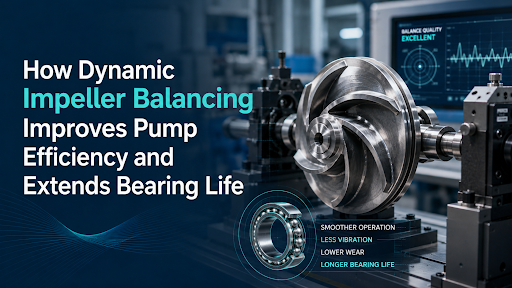
Dynamic impeller balancing is one of the simplest ways to protect a centrifugal pump from vibration, wear, and avoidable energy loss. For water pump manufacturers and plant owners alike, it directly supports better efficiency, smoother running, and longer bearing life.
What Balancing Means
An impeller is the rotating part that moves liquid through a centrifugal pump. If its mass is not evenly distributed, the pump runs out of balance and starts vibrating. Static balancing checks whether the impeller stays still in one position, while dynamic balancing checks how it behaves while rotating at speed. That makes dynamic balancing more complete and more relevant for real pump service.
Imbalance can develop for several reasons, including manufacturing tolerances, wear and corrosion, cavitation damage, material build-up, and improper repairs. Even a small change in weight distribution can create trouble over time.
Why it Matters
An unbalanced impeller creates excess vibration, shaft deflection, bearing failure, and mechanical seal leakage. It also increases energy consumption and reduces pump efficiency, which raises operating costs and lowers reliability. In short, the pump works harder to deliver the same output, and the entire system suffers.
How it is Done
Dynamic balancing is carried out on a balancing machine, where the impeller is spun, and the imbalance is measured. The technician then corrects it by removing or adding weight at specific points until the impeller rotates smoothly. This process follows ISO balancing standards, now covered under ISO 21940, which replaced the earlier ISO 1940 reference for balancing quality.
Benefits for Operations
When an impeller is properly balanced, the pump runs with lower vibration and less stress on moving parts. That usually means longer bearing life, reduced maintenance, lower operating costs, and improved hydraulic efficiency. It also helps avoid premature shutdowns in critical systems.
This is especially important in water treatment, HVAC, firefighting, chemical plants, and other process industries, where downtime can affect safety and output.
Signs and Maintenance
Common signs that a pump may need balancing include unusual vibration, rising noise, hot bearings, seal leaks, and a drop in performance. Preventive maintenance should include routine vibration checks, inspection for wear or deposit build-up, and prompt correction after repair work. Good balancing practice is not a one-time task. It is part of a consistent reliability programme.
At VEMPL, impeller balancing is supported through the APOEM facility and testing capabilities, helping ensure pumps are assembled, checked, and verified with reliability in mind. VEMPL has over 77 years of expertise in electromechanical engineering solutions and industrial pumps offered by leading water pump manufacturers. Reach out to us at +91 8976951701, +91 9819907445, 022 43117133, or email marketing@vemc.co.in.
Frequently Asked Questions (FAQs)
1. What is dynamic impeller balancing?
It is the process of correcting imbalance in a rotating impeller while it spins, so the pump runs smoothly.
2. How is it different from static balancing?
Static balancing checks balance at rest, while dynamic balancing checks balance during rotation and is more accurate for pumps.
3. What causes impellers to go out of balance?
Manufacturing tolerances, corrosion, cavitation, deposits, wear, and poor repair work are common causes.
4. Can imbalance damage bearings and seals?
Yes. Excess vibration can shorten bearing life and lead to seal leakage.
5. How often should pump balancing be checked?
It should be checked during maintenance, after major repairs, and whenever vibration or noise levels rise.