
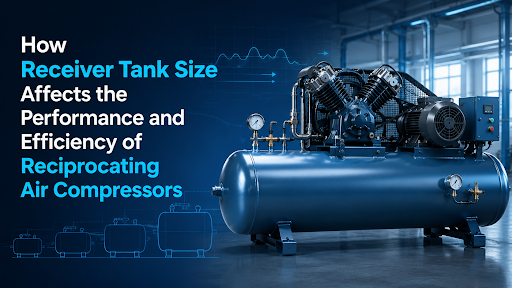
When specifying a compressed air system, the receiver tank is often treated as an afterthought. In reality, receiver sizing directly influences compressor cycling frequency, motor longevity, pressure stability, and overall system efficiency, particularly for reciprocating air compressors, which are sensitive to the demand conditions the receiver creates.
What Is an Air Receiver Tank?
An air receiver stores compressed air between the compressor and the distribution network. It serves four primary functions: storing air to meet demand peaks, stabilising system pressure, separating entrained moisture, and reducing compressor cycling by buffering demand variations.
Tank Size and Compressor Performance
For a reciprocating air compressor, receiver size directly determines cycling frequency. An undersized receiver causes rapid loading and unloading, accelerating wear on valves, piston rings, and the motor starter. Motors overheat due to excessive start frequency, significantly reducing service life. An oversized receiver, whilst rarely harmful mechanically, increases capital cost, footprint, and start-up pressurisation time without proportional benefit.
Pressure Fluctuations and Energy Implications
Pressure fluctuations at the point of use directly indicate receiver inadequacy. Where a reciprocating air compressor feeds equipment with variable demand, an undersized receiver cannot absorb demand spikes, causing pressure to drop below acceptable limits. Correct sizing smooths fluctuations, reduces unloaded running time, and delivers measurable energy savings across shift operations.
Sizing Guidelines
A commonly applied rule of thumb is 6–10 times the compressor’s free air delivery (FAD) per minute in litres. However, actual selection must account for air consumption patterns, the permissible pressure band (cut-in to cut-out differential), duty cycle, and peak demand duration. Industrial applications with highly variable demand, such as tyre manufacturing or metal fabrication, typically benefit from receivers at the upper end of this range. A common mistake is sizing based solely on compressor output without accounting for peak demand duration, leading to chronic pressure instability.
Safety and Maintenance
Receiver tanks are pressure vessels governed by the Indian Boilers Act and require valid inspection certification. Safety relief valves, pressure gauges, and manual drain valves are mandatory fittings. Condensate must be drained regularly, and internal inspection for corrosion carried out at manufacturer-specified intervals.
VEMPL has over 77 years of expertise in compressed air systems and industrial engineering solutions. We offer complete compressed air systems, including reciprocating air compressors and receiver selection across manufacturing and infrastructure sectors. Contact us now on +918976951701, +919819907445, 02243117133 or email us at marketing@vemc.co.in.
FAQs
1. What is the standard rule of thumb for sizing an air receiver?
Typically 6–10 times the compressor’s FAD per minute in litres, adjusted for demand patterns, pressure differential, and duty cycle.
2. How does an undersized receiver damage a reciprocating air compressor?
It causes excessive cycling, accelerating valve wear and motor overheating, significantly shortening the service life of the reciprocating air compressor.
3. Does a larger receiver always improve performance?
Not necessarily. Oversizing increases cost and footprint without proportional operational benefit.
4. What is the most common receiver selection mistake?
Sizing based on compressor output alone without considering peak demand duration results in an undersized receiver, chronic pressure drop, and accelerated reciprocating air compressor wear.