
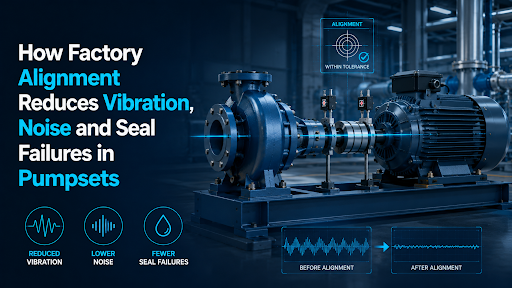
When investing in a pumpset, most buyers focus on flow rate, head, and efficiency. However, one critical factor that often goes unnoticed is factory alignment. Proper alignment plays a major role in ensuring smooth operation, reducing maintenance and extending the life of your equipment.
Leading water pump manufacturers understand that precision alignment is not just a quality check. It is the foundation of reliable pump performance.
What is pumpset alignment?
Pumpset alignment is the process of ensuring that the pump shaft and motor shaft are perfectly aligned. Even a slight deviation can place unnecessary stress on rotating components, leading to reduced efficiency and premature failure.
The three common types of misalignment include:
- Angular misalignment: The shafts meet at an angle rather than in a straight line.
- Parallel misalignment: The shafts remain parallel but are offset from one another.
- Soft foot: One or more motor feet do not sit evenly on the mounting surface, creating distortion when tightened.
What causes misalignment?
Misalignment can occur due to improper installation, uneven foundations, thermal expansion, pipe strain, or poor assembly practices. Even equipment that leaves the factory in perfect condition can develop alignment issues if installed incorrectly.
The impact of poor alignment
A poorly aligned pumpset can create several operational problems, including:
- Excessive vibration
- Increased operating noise
- Premature coupling wear
- Mechanical seal failures
- Bearing damage
- Shaft fatigue and failure
These issues not only increase maintenance costs but also lead to unexpected downtime and lower productivity.
How is alignment achieved?
Modern alignment methods offer greater precision than ever before.
- Dial indicator alignment is a traditional technique that measures shaft position manually. While effective, it requires considerable skill and experience.
- Laser alignment uses advanced measuring technology to deliver highly accurate results, reducing alignment time and improving long-term reliability.
Factory alignment also provides a significant advantage over site alignment. Precision assembly in a controlled manufacturing environment ensures that pumps leave the factory meeting stringent alignment tolerances before installation.
Why precision alignment matters
Correct alignment delivers measurable operational benefits, including:
- Reduced vibration and noise
- Lower maintenance costs
- Longer bearing and seal life
- Improved energy efficiency
- Increased equipment reliability
- Extended service life
Many alignment problems arise after installation due to pipe stress, uneven baseplates or inadequate foundation preparation. Following recommended installation practices and carrying out routine alignment checks helps maintain optimal performance throughout the equipment’s life.
Precision engineering at VEMPL
At VEMPL, every pumpset is assembled and tested using our APOEM assembly and testing process to ensure precise factory alignment before delivery. This commitment to quality helps customers achieve reliable performance from day one while reducing maintenance requirements over the long term.
Partner with VEMPL for reliable pumping solutions
Looking for dependable pumping systems backed by technical expertise? VEMPL supplies high-quality pumpsets from leading water pump manufacturers, supported by expert application guidance, precision assembly, installation assistance, and responsive after-sales service.
Contact VEMPL today to find the right pumping solution for your application and keep your operations running efficiently with confidence. Reach out to us on +91 8976951701, +91 9819907445, 022 43117133 or email marketing@vemc.co.in.
Frequently Asked Questions
1. Why is factory alignment important?
Factory alignment ensures the pump and motor are accurately assembled before installation, reducing the risk of vibration and premature component failure.
2. Can misalignment damage mechanical seals?
Yes. Misalignment places uneven loads on rotating components, often resulting in seal wear, leakage, and early failure.
3. Should alignment be checked after installation?
Absolutely. Even factory-aligned pumps should be verified after installation to account for foundation conditions and piping stresses.