
Introduction
Compressed air is often described as the “fourth utility” in industrial facilities because it supports a wide range of applications, from pneumatic tools and automation systems to process equipment, instrumentation, packaging, and manufacturing operations.
However, selecting the right compressor is critical.
A compressor that is too small may struggle to meet peak demand. A compressor that is too large may operate inefficiently and increase energy costs. Similarly, selecting a compressor technology that does not match the application’s duty cycle can lead to unnecessary maintenance, poor reliability, and higher lifecycle costs.
Two of the most widely used technologies for industrial compressed-air generation are reciprocating air compressors and screw air compressors.
This leads to an important question:
Reciprocating compressor vs screw compressor: which is better for industrial applications?
The answer is not simply that one technology is better than the other.
Both have specific advantages.
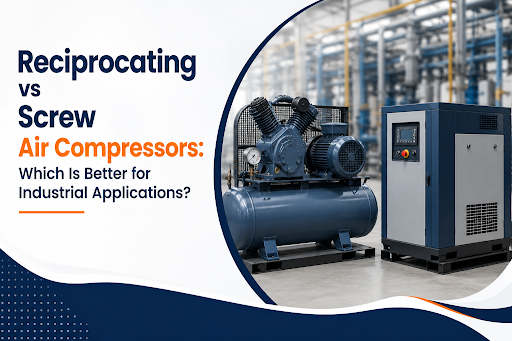
A reciprocating air compressor, also known as a piston compressor, uses reciprocating piston movement to compress air. It is particularly suitable for applications requiring high pressure, intermittent operation, or relatively lower air volumes.
A screw compressor uses rotating screw elements to continuously compress air and is generally well suited for applications requiring a steady and continuous supply of compressed air.
Therefore, the right selection depends on:
- Required air flow
- Required pressure
- Duty cycle
- Operating hours
- Air-demand pattern
- Space availability
- Energy consumption
- Maintenance requirements
- Air quality requirements
- Initial investment
- Lifecycle cost
This guide provides a detailed comparison of reciprocating compressor vs screw compressor technologies to help industrial users determine which solution is better suited to their application.
What Is a Reciprocating Air Compressor?
A reciprocating air compressor is a positive-displacement compressor that uses pistons moving back and forth inside cylinders to compress air.
The basic compression cycle consists of:
Suction → Compression → Discharge
During the suction stroke, air enters the cylinder through the inlet valve.
The piston then moves in the opposite direction, reducing the volume available for the air and increasing its pressure.
Once the required pressure is reached, the compressed air is discharged into the air receiver or downstream system.
Depending on the application, reciprocating compressors may be:
- Single-stage
- Two-stage
- Multi-stage
- Air-cooled
- Water-cooled
- Lubricated
- Oil-free
A reciprocating air compressor is particularly useful when the application requires high pressure, intermittent operation, or a relatively smaller compressed-air flow.
What Is a Screw Air Compressor?
A screw compressor is a rotary positive-displacement compressor that uses intermeshing helical rotors to continuously compress air.
As the rotors rotate, air enters the compression element, becomes trapped between the rotor profiles and casing, and is progressively compressed before being discharged.
Screw compressors are commonly available as:
- Oil-injected screw compressors
- Oil-free screw compressors
- Fixed-speed screw compressors
- Variable-speed drive screw compressors
Because compression occurs continuously rather than through individual piston strokes, screw compressors are particularly suitable for applications requiring a stable and continuous supply of compressed air.
Reciprocating Compressor vs Screw Compressor: At a Glance
The following comparison provides a quick overview.
| Parameter | Reciprocating Air Compressor | Screw Air Compressor |
| Compression principle | Reciprocating piston | Rotary screw |
| Air delivery | Pulsating | Continuous |
| Typical application | Intermittent/high-pressure demand | Continuous industrial demand |
| High-pressure capability | Excellent | Good to excellent depending on model |
| Continuous operation | Less suitable for some applications | Highly suitable |
| Variable demand | Can be suitable with proper control | Excellent with suitable control/VSD |
| Initial cost | Often lower for smaller capacities | Generally higher |
| Maintenance | More mechanical components | Generally lower routine mechanical intervention |
| Footprint | Can be compact for smaller capacities | Compact for continuous-duty applications |
| Noise/vibration | Generally higher | Generally lower |
| Air receiver requirement | Often important | Still required depending on system |
| Best suited for | Intermittent/high-pressure applications | Continuous air demand |
| Maintenance intervals | Generally more frequent | Generally longer depending on design |
| Energy efficiency | Strong in suitable operating conditions | Strong for continuous applications |
| Duty cycle | Intermittent to moderate | Continuous/high-duty |
These are general characteristics. Actual performance depends on compressor design, capacity, pressure, control system, operating conditions, and manufacturer specifications.
Reciprocating Compressor vs Screw Compressor: How Do They Work Differently?
The primary difference is the compression mechanism.
Reciprocating Compression
A reciprocating compressor uses piston movement.
The piston moves inside a cylinder and repeatedly compresses a fixed quantity of air.
This creates a pulsating discharge flow.
The compression process can be represented as:
Piston moves → Air is compressed → Air is discharged → Cycle repeats
Screw Compression
A screw compressor uses rotating screw elements.
Air is continuously trapped and compressed as it moves through the rotors.
The process is:
Air enters → Rotors trap air → Volume reduces → Pressure increases → Air exits
This continuous compression process makes screw compressors particularly suitable for plants where compressed-air demand remains relatively steady.
Piston Compressor vs Screw Compressor: Which Is More Suitable?
The piston compressor vs screw compressor decision should begin with the application rather than the compressor technology.
Ask these questions first:
- How much air is required?
- What pressure is required?
- How many hours per day will the compressor operate?
- Is the air demand continuous or intermittent?
- Is demand relatively constant or highly variable?
- Is high pressure required?
- Is low noise important?
- What maintenance resources are available?
- What is the expected equipment life?
- What is the total cost of ownership?
These questions help determine the appropriate technology.
When Is a Reciprocating Air Compressor Better?
A reciprocating air compressor can be an excellent choice when the application requires:
- High pressure
- Intermittent compressed-air demand
- Relatively lower air volume
- High pressure-to-flow requirements
- Smaller operating cycles
- Specific process applications
- Pneumatic tools
- Workshops
- Smaller industrial applications
For example, if an application requires compressed air periodically rather than continuously, a reciprocating compressor can provide an efficient solution without the need for a large continuous-duty compressor.
When Is a Screw Compressor Better?
A screw compressor is generally preferred when the application requires:
- Continuous compressed-air supply
- High operating hours
- Consistent air demand
- Large air volume
- Lower pulsation
- Continuous production
- Automated manufacturing
- Centralised compressed-air systems
Industries with continuous pneumatic equipment often benefit from the operating characteristics of screw compressors.
Key Factors to Consider Before Selecting a Compressor
1. Air Flow Requirement
One of the most important compressor-selection parameters is required airflow.
Air demand is commonly expressed in units such as:
- CFM
- m³/min
- m³/hr
- L/s
The compressor should be selected based on actual system demand rather than simply choosing a compressor with the largest possible capacity.
Oversizing can increase:
- Capital cost
- Energy consumption
- Unloaded running
- System inefficiency
Undersizing can result in:
- Pressure drops
- Inability to meet peak demand
- Continuous operation at high load
- Reduced equipment life
2. Required Pressure
The required pressure should be determined from the actual application.
Different applications may require different pressures.
Examples include:
- Pneumatic tools
- Instrumentation
- Manufacturing machinery
- Process equipment
- Cleaning
- Packaging
- Automation
- Blow moulding
- Specialised industrial processes
A compressor should not be selected solely on its maximum pressure rating.
The more important question is:
What pressure is required at the point of use while accounting for system pressure losses?
3. Duty Cycle
Duty cycle is one of the most important considerations in the reciprocating compressor vs screw compressor decision.
If a compressor operates only occasionally, a reciprocating compressor may be appropriate.
If compressed air is required continuously for several hours every day, a screw compressor may provide a more suitable solution.
Simplified approach:
Intermittent Demand → Consider Reciprocating
Continuous Demand → Consider Screw
This is a useful starting point, but final selection should consider actual flow, pressure, control strategy, and manufacturer data.
4. Operating Hours
Operating hours strongly influence lifecycle cost.
For equipment operating only a few hours per day, initial purchase cost may have greater influence.
For equipment operating continuously, energy consumption becomes increasingly important.
For example:
Compressor Power × Operating Hours × Electricity Cost = Significant Lifecycle Cost
Therefore, a compressor with a slightly higher initial investment may potentially provide a better economic outcome if it delivers lower energy consumption over its operating life.
5. Air Demand Pattern
Industrial air demand is rarely perfectly constant.
Demand may vary because of:
- Production shifts
- Different machines operating at different times
- Seasonal changes
- Batch production
- Peak production periods
- Weekend shutdowns
Understanding the demand profile is therefore important.
A variable-speed screw compressor may be useful in applications with significant demand variation, provided the compressor is correctly selected and operated within its intended range.
A reciprocating compressor may also be effective for intermittent or cyclic applications.
Reciprocating Compressor vs Screw Compressor: Energy Efficiency
Energy efficiency should be evaluated over the entire operating range.
It is not sufficient to compare only the rated motor power.
The assessment should consider:
- Actual airflow
- Pressure
- Specific power
- Loading/unloading behaviour
- Operating hours
- Control method
- Leakage
- Pressure drop
- Cooling requirements
- System demand profile
Why This Matters
Compressed-air systems can consume significant electrical energy.
Even a small improvement in compressor efficiency can generate meaningful savings when the equipment operates for thousands of hours per year.
Therefore, compressor selection should consider lifecycle energy cost, not only initial purchase price.
Fixed-Speed vs Variable-Speed Screw Compressors
Screw compressors are available with different control approaches.
Fixed-Speed Screw Compressor
A fixed-speed compressor generally operates at a fixed motor speed and uses a control strategy to match supply with demand.
It can be suitable for applications where air demand remains relatively stable.
Variable-Speed Drive Screw Compressor
A variable-speed compressor adjusts motor speed according to compressed-air demand.
Potential benefits include:
- Better matching of supply with demand
- Reduced unloaded operation
- Potential energy savings
- Improved pressure control
However, VSD compressors should be selected based on the actual demand profile.
A variable-speed compressor is not automatically the most efficient solution for every application.
Advantages of a Reciprocating Air Compressor
1. High-Pressure Capability
Reciprocating compressors are well suited to applications requiring relatively high pressure.
2. Suitable for Intermittent Operation
They can be useful when compressed-air demand occurs in cycles rather than continuously.
3. Strong Compression Performance
The positive-displacement principle can provide effective compression across a wide range of applications.
4. Suitable for Smaller Air Requirements
For lower-volume applications, a reciprocating compressor may offer a practical solution.
5. Flexible Configuration
Single-stage and multi-stage configurations can be selected depending on pressure requirements.
Limitations of Reciprocating Air Compressors
Despite their advantages, reciprocating compressors have some limitations.
These may include:
- Pulsating airflow
- Higher vibration
- More moving components
- Greater mechanical wear
- More frequent maintenance requirements
- Noise
- Less suitability for certain continuous-duty applications
These factors should be considered when selecting a compressor for a production environment.
Advantages of Screw Air Compressors
1. Continuous Air Supply
The rotary compression process produces a continuous compressed-air flow.
2. Suitable for High Operating Hours
Screw compressors are widely used in industrial plants requiring continuous compressed air.
3. Lower Pulsation
Continuous compression provides smoother air delivery than piston-based compression.
4. Compact Industrial Package
Screw compressors can provide substantial air delivery in a relatively compact package.
5. Suitable for Automated Production
Their continuous operation makes them suitable for manufacturing environments with consistent compressed-air requirements.
6. Variable-Speed Options
VSD screw compressors can help match compressor output to variable air demand.
Limitations of Screw Air Compressors
Potential considerations include:
- Higher initial investment in some applications
- More specialised servicing
- Need for appropriate air/oil separation in oil-injected designs
- Sensitivity to operating conditions
- Energy losses if poorly selected or operated at low load
- Requirement for proper cooling and ventilation
Therefore, screw compressors should also be correctly sized rather than selected simply because they are considered an industrial standard.
Reciprocating Compressor vs Screw Compressor: Maintenance Comparison
Maintenance requirements differ because the mechanical designs are different.
| Maintenance Factor | Reciprocating Compressor | Screw Compressor |
| Piston/ring inspection | Important | Not applicable |
| Valve maintenance | Important | Not applicable in same form |
| Lubrication | Important | Important depending on design |
| Bearing inspection | Required | Required |
| Air/oil separator | Not applicable in same form | Important for oil-injected units |
| Intake filter | Required | Required |
| Cooling system | Required | Required |
| Vibration monitoring | Important | Important |
| Oil condition | Important for lubricated units | Important for oil-injected units |
| Routine servicing | Generally more mechanical | Generally more system-based |
Regardless of compressor type, preventive and predictive maintenance are essential for reliable operation.
Why Compressor Maintenance Matters
A compressor that is not maintained properly can experience:
- Reduced airflow
- Increased energy consumption
- Higher discharge temperature
- Oil carryover
- Increased vibration
- Reduced component life
- Unplanned shutdowns
A structured maintenance programme should cover:
- Air filters
- Oil filters
- Lubricant
- Cooling system
- Belts or couplings where applicable
- Bearings
- Valves where applicable
- Air/oil separator
- Electrical components
- Pressure settings
- Leakage
- Safety systems
Air Receiver and Compressor Selection
An air receiver can play an important role in compressed-air systems.
It can help:
- Store compressed air
- Handle short-term demand fluctuations
- Reduce rapid compressor cycling
- Stabilise system pressure
- Support peak demand
However, an air receiver should not be used to compensate for an incorrectly sized compressor.
The complete system should be evaluated:
Compressor + Air Receiver + Dryer + Filters + Distribution Piping + End-Use Equipment
Why Compressed-Air System Design Matters
Selecting the compressor is only one part of building an efficient compressed-air system.
Pressure losses can occur through:
- Undersized piping
- Excessive bends
- Filters
- Dryers
- Valves
- Poorly designed distribution networks
A compressor may therefore be operating correctly while the end-use equipment receives inadequate pressure.
This is why compressor selection should consider the entire compressed-air system.
Reciprocating Compressor vs Screw Compressor for Different Industries
| Application | Generally Suitable Technology |
| Small workshop | Reciprocating |
| Intermittent pneumatic tools | Reciprocating |
| High-pressure intermittent application | Reciprocating |
| Continuous manufacturing | Screw |
| Automated production line | Screw |
| Large pneumatic system | Screw |
| Continuous process air | Screw |
| Variable industrial air demand | VSD screw may be suitable |
| Special high-pressure requirement | Reciprocating or specialised compressor |
These are general recommendations. Actual selection depends on the application’s required flow, pressure, operating hours and air-quality requirements.
Reciprocating Air Compressor vs Screw Compressor: Cost Considerations
Initial purchase price is only one part of compressor economics.
A proper evaluation should consider:
Initial Cost
Includes:
- Compressor
- Motor
- Controls
- Receiver
- Dryer
- Filters
- Installation
Operating Cost
Includes:
- Electricity
- Lubricant
- Cooling
- Consumables
- Maintenance
Downtime Cost
Includes:
- Production loss
- Emergency repairs
- Labour
- Replacement components
Lifecycle Cost
A useful simplified framework is:
Lifecycle Cost = Capital Cost + Energy Cost + Maintenance Cost + Downtime Cost
For equipment operating continuously, energy cost can become one of the largest components.
How to Choose Between Reciprocating and Screw Compressors
Use the following decision framework.
Choose a Reciprocating Air Compressor When:
- Air demand is intermittent.
- Required airflow is relatively low.
- High pressure is important.
- The compressor does not need to operate continuously.
- The application can accommodate pulsating airflow.
- Initial investment is an important consideration.
Consider a Screw Compressor When:
- Air demand is continuous.
- The compressor operates for long hours.
- Stable compressed-air delivery is required.
- Large air volumes are needed.
- Lower pulsation is preferred.
- The plant requires continuous production of air.
- Variable-speed operation can provide value.
Common Compressor Selection Mistakes
Mistake 1: Selecting Only Based on Motor HP
Motor horsepower alone does not determine whether a compressor is suitable.
Always evaluate:
Flow + Pressure + Specific Power + Duty Cycle + Control Method
Mistake 2: Oversizing the Compressor
An oversized compressor may operate inefficiently, particularly when demand is substantially below rated capacity.
Mistake 3: Ignoring Peak Demand
Selecting only for average demand may result in pressure drops during peak production.
Mistake 4: Ignoring Air Leakage
Compressed-air leaks can create significant unnecessary demand.
Before installing a larger compressor, the existing system should be checked for leakage.
Mistake 5: Ignoring Pressure Drop
Pressure loss through dryers, filters, and piping can affect end-use performance.
Mistake 6: Comparing Only Purchase Price
A cheaper compressor is not necessarily the cheaper compressor to own.
Energy and maintenance costs should be considered over the equipment’s expected life.
Practical Example: Reciprocating vs Screw Compressor
Consider two different industrial applications.
Application A: Small Workshop
The facility requires compressed air for pneumatic tools for short periods throughout the day.
Demand is intermittent.
A reciprocating air compressor may be appropriate because the equipment does not need to run continuously.
Application B: Continuous Manufacturing Plant
A manufacturing facility operates multiple pneumatic machines throughout multiple shifts.
Compressed-air demand remains relatively stable throughout the production period.
A screw compressor may be more appropriate because it is designed for continuous-duty applications and provides a steady compressed-air supply.
The examples demonstrate why there is no universal winner in the reciprocating compressor vs screw compressor debate.
The correct choice depends on the application.
How to Improve Compressor Selection Accuracy
Before purchasing a compressor, collect actual operating data.
Recommended information:
- Current compressor capacity
- Actual airflow
- Operating pressure
- Peak pressure requirement
- Average demand
- Peak demand
- Operating hours
- Shift pattern
- Existing compressor loading
- Electricity consumption
- Air leakage
- Pressure drop
- Air quality requirement
- Future expansion plans
This information allows the compressor supplier to recommend a system based on actual requirements rather than assumptions.
Why Working with the Right Compressor Supplier Matters
Industrial compressor selection requires more than identifying the required motor size.
A capable compressor supplier should be able to assist with:
- Air-demand assessment
- Compressor selection
- System sizing
- Air receiver selection
- Dryer selection
- Filtration
- Installation
- Commissioning
- Preventive maintenance
- Compressor servicing
- Energy optimisation
- Troubleshooting
For industrial users, technical support after installation can be just as important as the initial compressor purchase.
Frequently Asked Questions
1. What is the difference between a reciprocating compressor and a screw compressor?
A reciprocating compressor uses pistons moving inside cylinders to compress air, while a screw compressor uses rotating screw elements to provide continuous compression. Reciprocating compressors are often suitable for intermittent or high-pressure applications, while screw compressors are widely used for continuous industrial air demand.
2. Which is better, a reciprocating compressor or screw compressor?
Neither technology is universally better. A reciprocating compressor can be better for intermittent operation, lower airflow, and high-pressure applications, while a screw compressor is generally better suited to continuous, high-volume industrial air demand.
3. Is a piston compressor the same as a reciprocating compressor?
Yes. A piston compressor is commonly referred to as a reciprocating compressor because the piston moves back and forth inside the cylinder during the compression cycle.
4. What is the difference between a piston compressor vs screw compressor?
A piston compressor uses reciprocating piston movement, while a screw compressor uses rotating helical rotors. Piston compressors are often suited to intermittent and high-pressure applications, whereas screw compressors are commonly used for continuous industrial compressed-air requirements.
5. Which compressor is more suitable for continuous operation?
A screw compressor is generally well suited to continuous-duty industrial applications because it provides a continuous flow of compressed air and is designed for extended operating periods.
6. Which compressor is better for high pressure?
Reciprocating compressors can be particularly suitable for high-pressure applications, especially where the required airflow is relatively lower. The final choice should be based on the specified pressure, flow and application requirements.
7. Which compressor requires more maintenance?
Reciprocating compressors generally have more reciprocating mechanical components, such as pistons, piston rings and valves, that require periodic attention. Screw compressors also require maintenance of filters, lubricant systems, separators, bearings and other components. Actual maintenance requirements depend on compressor design and operating conditions.
8. Are screw compressors more energy efficient than reciprocating compressors?
Not necessarily in every application. Efficiency depends on operating pressure, airflow, duty cycle, control method, loading pattern and system design. A correctly selected compressor operating near its intended conditions is generally more important than the technology alone.
9. Is a variable-speed screw compressor always the best choice?
No. A VSD screw compressor can be highly useful when compressed-air demand varies significantly, but the demand profile should be analysed before selecting the compressor. A fixed-speed compressor or reciprocating compressor may be more appropriate in other applications.
10. What compressor should I choose for a small workshop?
A reciprocating air compressor is often suitable for small workshops where compressed-air demand is intermittent and relatively low. However, pressure, airflow, operating hours and application requirements should be considered before final selection.
11. What compressor is better for a manufacturing plant?
For manufacturing facilities requiring continuous compressed air across multiple production machines, a screw compressor is often a suitable option. The actual selection should be based on measured air demand and operating conditions.
12. How do I calculate the required compressor capacity?
Compressor capacity should be based on the total air consumption of connected equipment, operating diversity, peak demand, required pressure, and an appropriate allowance for future requirements. Actual demand measurement is preferable to simply adding nameplate air consumption.
13. Does an air receiver improve compressor performance?
An appropriately sized air receiver can help manage short-term demand fluctuations, reduce unnecessary compressor cycling and stabilise system pressure. It cannot compensate for an incorrectly sized or inefficient compressor.
Reciprocating Compressor vs Screw Compressor: Final Verdict
The question “reciprocating compressor vs screw compressor — which is better?” does not have a single answer.
The better compressor is the one that matches the actual application.
A reciprocating air compressor is generally worth considering when:
- Air demand is intermittent.
- High pressure is required.
- Airflow requirements are relatively lower.
- The compressor does not need to run continuously.
- The application can accommodate pulsating delivery.
A screw compressor is generally worth considering when:
- Air demand is continuous.
- The compressor operates for long hours.
- Stable airflow is important.
- Higher air volumes are required.
- The application is part of a continuous manufacturing process.
The piston compressor vs screw compressor decision should ultimately be based on the complete lifecycle of the compressed-air system.
Consider:
Air Demand → Pressure → Duty Cycle → Operating Hours → Control Strategy → Energy Consumption → Maintenance → Lifecycle Cost
A properly selected compressor can provide reliable compressed-air availability while helping control energy and maintenance costs.
Need Help Selecting the Right Industrial Air Compressor?
Choosing between a reciprocating air compressor and a screw compressor should begin with understanding your actual compressed-air requirements.
Vijay Engineering and Machinery Pvt Ltd (VEMPL), an authorised channel partner for ELGi Equipments Limited in Mumbai, Thane and Raigad, supports industrial customers with compressed-air solutions and technical assistance.
The right solution can be evaluated based on:
- Required airflow
- Operating pressure
- Duty cycle
- Operating hours
- Air-demand profile
- Energy consumption
- Future expansion
- Maintenance requirements
If you are evaluating a reciprocating compressor vs. a screw compressor for your facility, contact VEMPL to discuss your application and identify the compressor configuration suited to your operating requirements.