
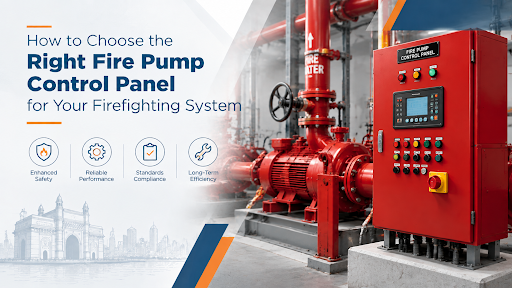
A reliable firefighting system depends on more than selecting the right fire pump. The fire pump control panel plays an important role in controlling and monitoring the pump when water is required during a fire emergency.
Whether you are designing a new building, upgrading an existing fire protection system, or replacing an older control panel, selecting the appropriate equipment is essential for system reliability and operational readiness.
The right choice depends on several factors, including the type of fire pump, motor rating, starting method, electrical supply, applicable standards, monitoring requirements, and supplier support.
This guide explains the important considerations when selecting a control panel for your firefighting system.
What Is a Fire Pump Control System?
A fire pump control system is an electrical or engine-control arrangement designed to operate and monitor a fire pump. Depending on the system design, it can support automatic starting, manual operation, status indication, and fault monitoring.
In a typical automatic firefighting system, a reduction in water pressure may initiate the pump-start sequence through the designated sensing arrangement. The control system then operates the pump according to the approved design and applicable requirements.
Control arrangements may be used with:
- Electric motor-driven fire pumps
- Diesel engine-driven fire pumps
- Jockey pumps
- Fire hydrant systems
- Sprinkler systems
- Dedicated fire water pumping systems
The exact configuration depends on the pump type, driver, electrical or engine requirements, and overall firefighting system design.
Why Is the Pump Control System Important?
The fire pump delivers water at the required flow and pressure, while its control system provides the operating and monitoring functions needed for the pump to work as part of the firefighting installation.
A properly selected control arrangement can support:
- Reliable pump starting
- Automatic and manual operating modes
- Pump running indication
- Monitoring of relevant operating conditions
- Fault and alarm indication
- Electrical status monitoring
- Coordination with the overall fire protection system
For critical fire protection applications, the control system should be selected as part of the complete pumping arrangement rather than as an isolated electrical component.
How Does a Fire Pump Control System Work?
The operating sequence depends on the type of pump, system arrangement, and approved fire protection design.
In a typical automatic installation, a pressure change in the fire water system can initiate the pump-start sequence through the designated sensing arrangement. The controller receives the relevant signal and initiates the required pump operation.
Depending on the configuration, the system may provide:
- Automatic starting
- Manual starting
- Pump running indication
- Power availability indication
- Fault or alarm indication
- Monitoring of relevant electrical parameters
- Permitted stop functions
The precise sequence must be established according to the applicable fire protection standards and project specifications.
7 Factors to Consider When Choosing a Fire Pump Control Panel
1. Identify the Type of Fire Pump
The first step is to determine which pump the control equipment will operate.
Common arrangements include:
- Electric motor-driven fire pumps
- Diesel engine-driven fire pumps
- Jockey pumps
- Multiple-pump firefighting systems
An electric pump requires a different control arrangement from a diesel-driven pump because the operating and starting requirements differ.
Before selecting the equipment, confirm the pump type, driver details, intended application, and approved system arrangement.
2. Check the Motor Rating and Electrical Requirements
For an electric fire pump, the control equipment must be suitable for the motor and electrical supply.
Important details include:
| Parameter | Information Required |
| Motor power | kW or HP |
| Voltage | Rated voltage |
| Phase | Single-phase or three-phase, as applicable |
| Frequency | Hz |
| Full-load current | A |
| Starting current | As specified for the motor |
| Starting method | As per approved design |
| Incoming supply | Available electrical supply |
| Short-circuit requirements | As specified for the installation |
Providing accurate motor details to the supplier helps ensure that the selected equipment is properly matched to the pump motor and electrical system.
Incorrect or incomplete motor information can result in an unsuitable configuration.
3. Understand the Required Starting Method
The starting method is another important consideration.
Depending on the application, motor rating, electrical supply, project specifications, and applicable requirements, different starting arrangements may be used.
The selection should take into account:
- Motor rating
- Available power supply
- Starting characteristics
- Project specifications
- Fire protection requirements
- Applicable standards
- Approved system design
A standard configuration may not be suitable for every installation. The starting arrangement should therefore be determined during the design and equipment-selection process.
4. Check Applicable Fire Protection Standards
Fire protection equipment must be selected with careful attention to the applicable standards, codes, and project specifications.
Depending on the project location and application, requirements may involve:
- NFPA 20, where applicable
- Relevant Indian Standards
- National Building Code requirements
- Authority requirements
- Insurance requirements
- Consultant specifications
- Project-specific approval conditions
The applicable requirements should be confirmed by the project consultant, fire protection professional, or relevant authority.
It is important to distinguish between general motor-control equipment and equipment specifically designed and configured for a fire protection application.
5. Evaluate Protection and Monitoring Features
Control equipment can include several monitoring and indication functions. The required features depend on the pump arrangement and project specifications.
Potential features include:
- Power available indication
- Pump running indication
- Pump start indication
- Fault indication
- Phase-related monitoring
- Protection functions, where applicable
- Local status indication
- Alarm contacts
- Remote monitoring interfaces
The objective is to provide operators and facility management personnel with the information required to understand the pump’s operating status.
The supplier should clarify which features are included and which are optional or project-specific.
6. Consider Manual and Automatic Operation
The control system should provide the operating modes required by the firefighting system.
Automatic operation is important because a fire pump may need to start without waiting for manual intervention. Manual controls may also be required for testing, maintenance, and specific operating situations.
The operating sequence, controls, and stop functions should follow the approved system design and applicable fire protection requirements.
Before purchasing the equipment, confirm how automatic starting, manual operation, testing, and alarm indications will function.
7. Choose a Reliable Manufacturer or Supplier
The supplier’s technical capability is as important as the equipment itself.
Before purchasing, evaluate whether the supplier can provide:
- Technical selection assistance
- Product documentation
- Factory testing, where required
- Installation assistance
- Commissioning support
- Troubleshooting
- Spare components
- After-sales service
A supplier with relevant technical knowledge can help coordinate the pump, control equipment, electrical supply, and other parts of the firefighting system.
What Components Are Found in a Pump Control Panel?
The components depend on the design, pump type, driver, and applicable requirements.
A typical arrangement may include:
- Controller
- Contactors or switching equipment, where applicable
- Circuit protection devices
- Motor protection components
- Control transformers or power supplies, where applicable
- Pressure-sensing interface
- Indicating lamps or display
- Start and stop controls, as applicable
- Alarm and monitoring interfaces
- Terminals for external connections
Diesel-driven pump arrangements may also include engine-related controls, battery monitoring, and other functions required by the engine and pump package.
The component selection should be based on the approved electrical design and applicable fire protection requirements.
Control Equipment for Electric Fire Pumps
An electric fire pump requires a dedicated arrangement to operate its motor and provide the necessary monitoring functions.
When selecting equipment for an electric pump, consider:
- Motor rating
- Voltage
- Phase
- Frequency
- Full-load current
- Starting method
- Electrical supply
- Project specifications
- Applicable fire protection standards
The equipment should be coordinated with the fire pump, electrical supply, and overall firefighting system.
Control Equipment for Diesel Fire Pumps
A diesel fire pump uses an engine rather than an electric motor as its primary driver. Consequently, its control requirements differ from those of an electric pump.
A diesel pump control arrangement may need to monitor and manage functions associated with the engine, including:
- Engine starting
- Battery condition
- Engine running
- Engine fault conditions
- Fuel-related indications
- System pressure
- Alarm conditions
The exact configuration should be established according to the diesel pump package, approved system design, and applicable fire protection requirements.
Fire Pump Control Panel vs. Jockey Pump Control Panel
A firefighting system may contain both a main fire pump and a jockey pump.
The main fire pump is designed to provide the required firefighting water flow and pressure. The jockey pump helps maintain system pressure under normal conditions and compensates for minor pressure losses.
Because these pumps serve different purposes, their control requirements also differ.
A firefighting installation may use separate control arrangements or an integrated solution, depending on the system design.
When selecting equipment, clearly identify whether it is intended for:
- The main electric fire pump
- The diesel fire pump
- The jockey pump
- A multiple-pump arrangement
This distinction helps ensure that the selected configuration matches the intended application.
How to Select the Right Equipment for Your Project
Before approaching a supplier, collect the technical information required for proper selection.
| Parameter | Information Required |
| Pump type | Electric, diesel, or jockey |
| Motor rating | kW or HP |
| Voltage | V |
| Phase | As applicable |
| Frequency | Hz |
| Full-load current | A |
| Starting method | As per approved design |
| Pump duty | Flow and head |
| Power supply | Available electrical supply |
| Installation | Indoor or outdoor |
| Monitoring | Local or remote, as required |
| Applicable standards | Project-specific |
| Application | Hydrant, sprinkler, or fire water system |
Providing these details helps the supplier assess the required configuration and identify any additional information needed before preparing a quotation.
Why Equipment Quality Matters
A firefighting system may remain unused for long periods, but it must be ready to operate when required. This makes reliability an important consideration when selecting control equipment.
Important factors include:
- Component quality
- Correct electrical sizing
- Proper wiring
- Suitable enclosure
- Component accessibility
- Clear labelling
- Testing
- Documentation
- Ease of maintenance
The equipment should also be properly integrated with the fire pump and other components of the firefighting system.
A suitable design, correct installation, and appropriate maintenance are important for maintaining system readiness.
What Testing Should Be Considered?
Testing requirements depend on the equipment design, project specifications, and applicable standards.
Before commissioning, appropriate checks may include:
- Visual inspection
- Wiring verification
- Component checks
- Electrical testing
- Control sequence verification
- Manual operation checks
- Automatic operation checks
- Alarm and indication checks
- Interface checks
- Functional testing with the fire pump
Factory testing or inspection may also be required before dispatch for certain projects.
The supplier should provide the required documentation and support the testing process according to the approved project requirements.
Common Mistakes to Avoid
Selecting Equipment Only Based on Price
A lower initial price does not necessarily mean a suitable solution. Fire protection equipment should be evaluated based on compatibility, reliability, applicable requirements, documentation, and service support, along with cost.
Not Checking Motor Details
Incorrect motor information can result in an unsuitable configuration. Always verify the motor rating, voltage, current, and starting requirements before placing an order.
Ignoring Project Specifications
Fire protection projects may have specific consultant, authority, or client requirements. Equipment should be evaluated against the approved specifications and applicable standards.
Choosing a Supplier Without Service Support
A supplier should be able to assist with delivery. Installation, testing, commissioning, troubleshooting, and maintenance support may be important throughout the operating life of the equipment.
Why Choose an Experienced Supplier?
Selecting suitable fire pump equipment involves coordinating several technical requirements. An experienced supplier should understand:
- Fire pump applications
- Electrical requirements
- Pump starting methods
- Fire protection system requirements
- Control equipment configuration
- Testing
- Commissioning
- After-sales support
This understanding can help consultants, contractors, developers, and facility owners assess equipment requirements more effectively.
VEMPL – Pumping and Control Solutions
Vijay Engineering & Machinery Pvt. Ltd. (VEMPL) provides pumping and related solutions for building, commercial, industrial, and infrastructure applications.
As an authorized channel partner of Kirloskar Brothers Limited (KBL), VEMPL supports customers with Kirloskar pumps, control equipment, motors, and genuine spares.
For firefighting applications, VEMPL can assist customers in evaluating pumping and control requirements according to project specifications and application needs.
The objective is to support a coordinated pumping solution rather than treating the pump and its control arrangement as completely separate components.
Consultants, contractors, developers, and facility teams can discuss their pump type, motor rating, electrical requirements, and project specifications with VEMPL to identify a suitable solution.
Frequently Asked Questions
1. What does a fire pump control system do?
It operates and monitors a fire pump according to the approved firefighting system design. Depending on its configuration, it may provide automatic and manual starting, status indication, alarm indication, and monitoring functions.
2. How do I select the right equipment for my fire pump?
Start by identifying the pump type, motor rating, voltage, phase, current, starting method, power supply, and project requirements. The equipment should then be selected according to the complete firefighting system design.
3. Can the same control arrangement be used for every fire pump?
No. Electric, diesel, and jockey pumps have different operating and control requirements. The selected arrangement must be suitable for the specific pump and system.
4. What standards may apply to firefighting pump control equipment?
Requirements depend on the project, location, and system design. They may include NFPA 20, relevant Indian Standards, National Building Code provisions, authority requirements, and project-specific specifications. The applicable requirements should be confirmed with the relevant project professionals.
5. What information is needed to obtain a quotation?
Suppliers generally need details such as pump type, motor rating, voltage, phase, frequency, full-load current, starting method, pump duty, power supply, application, and applicable project requirements.
6. Does pump control equipment require maintenance?
Yes. Inspection and maintenance are important for firefighting systems. The specific requirements depend on the equipment design, manufacturer’s recommendations, and applicable fire protection requirements.
7. Can control equipment be connected to a building management or fire alarm system?
Depending on the design and configuration, relevant status and alarm signals may be made available for integration with other building or fire protection systems. The required interfaces should be established during project planning.
8. How much does fire pump control equipment cost?
The cost depends on the pump type, motor rating, starting arrangement, components, enclosure, monitoring requirements, applicable standards, and project specifications. A quotation should be prepared according to the actual project requirements.
Conclusion
Selecting suitable control equipment is an important part of designing and maintaining a reliable firefighting system.
Before purchasing, consider the pump type, motor rating, electrical requirements, starting method, monitoring features, applicable standards, testing requirements, documentation, and supplier support.
A supplier with relevant technical knowledge can help coordinate the pump, control arrangement, and wider firefighting system according to the approved project design.
Looking for a suitable pumping and control solution for your next project? Share your pump type, motor rating, voltage, and project requirements with VEMPL for assistance with evaluating the appropriate equipment.