
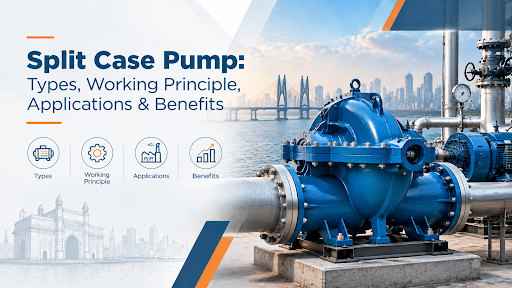
A split case pump is a centrifugal pumping solution commonly considered for applications requiring high flow rates, dependable water transfer, and extended operation. Its casing design provides access to internal components, which can make inspection and maintenance more convenient.
These pumps are commonly considered for water supply, HVAC systems, fire-fighting installations, industrial processes, cooling-water systems, and infrastructure projects.
But how does this type of centrifugal pump work? What are its different configurations, where is it used, and what factors should be considered before selection?
This guide explains the working principle, types, applications, benefits, selection parameters, maintenance requirements, and common troubleshooting considerations.
What Is a Split Case Pump?
A split case pump is a centrifugal pump with a casing divided into two sections. In a horizontal configuration, the casing is generally divided along the shaft centreline.
This construction can provide convenient access to components such as the impeller, shaft, bearings, and seals during inspection and maintenance.
A typical unit may consist of:
- Pump casing
- Impeller
- Shaft
- Bearings
- Mechanical seals or packing arrangement
- Coupling
- Baseplate
- Motor or other driver
The exact construction varies according to the pump design, application, operating conditions, and manufacturer.
Because of their hydraulic characteristics and construction, split-case centrifugal pumps are frequently considered for large water-handling applications.
How Does a Split Case Pump Work?
The working principle is based on centrifugal force and the conversion of mechanical energy into fluid energy.
Step 1: Fluid Enters the Pump
Water or another suitable fluid enters through the suction connection and reaches the impeller.
Step 2: The Impeller Rotates
The motor transfers mechanical energy through the shaft to rotate the impeller.
Step 3: Fluid Velocity Increases
As the impeller rotates, it moves the fluid outward from its centre. This increases the velocity of the fluid.
Step 4: Velocity Is Converted Into Pressure
The casing guides the moving fluid while part of its velocity energy is converted into pressure energy.
Step 5: Fluid Leaves Through the Discharge
The pressurised fluid exits through the discharge connection and moves into the downstream piping system.
In simple terms, the pump uses mechanical energy from the driver to increase the pressure and move the fluid through the system.
What Are the Different Types of Split Case Pumps?
Split-case pumping equipment can be classified according to casing arrangement, shaft orientation, number of stages, and hydraulic configuration.
1. Horizontal Split Case Pump
A horizontal configuration has a casing divided along the horizontal centreline. This arrangement is commonly considered for large water-flow applications where access to internal components is important.
Typical applications include:
- Water supply
- HVAC systems
- Fire-fighting systems
- Industrial water circulation
- Cooling-water systems
- Infrastructure projects
2. Vertical Split Case Arrangement
A vertical arrangement uses a different shaft and installation configuration. The appropriate design depends on the application, available installation space, suction conditions, and hydraulic requirements.
3. Single-Stage Configuration
A single-stage design uses one impeller stage to produce the required pressure or head. It can be suitable where the required duty can be achieved using a single hydraulic stage.
4. Multistage Configuration
A multistage design uses multiple impeller stages to achieve higher pressure or head requirements.
The choice between single-stage and multistage equipment depends on the required flow, head, system characteristics, and application.
What Are the Main Applications?
Split-case centrifugal pumps can be considered for a wide range of high-flow water-handling requirements.
Water Supply and Transfer
They can be used to move water between reservoirs, tanks, treatment facilities, and distribution systems.
Applications may include:
- Raw-water transfer
- Treated-water transfer
- Water distribution
- Reservoir pumping
- Utility-water systems
HVAC Systems
Large commercial buildings, hospitals, hotels, and industrial facilities require water circulation for heating, ventilation, and air-conditioning systems.
These pumps may be considered for chilled-water and condenser-water applications when their flow and head characteristics match the system requirements.
Fire-Fighting Systems
Fire-fighting systems require pumping equipment capable of delivering the required water flow and pressure.
Split-case configurations may be considered for fire-water applications where the pump duty and configuration comply with the applicable project and fire-protection requirements.
Industrial Applications
Industrial facilities use pumps for various process and utility-water requirements, including:
- Cooling water
- Process water
- Utility water
- Circulation systems
- Water transfer
- Industrial water supply
Cooling-Water Systems
Manufacturing facilities, power plants, and process industries may require continuous cooling-water circulation. Pump selection should consider the required flow, head, fluid characteristics, operating hours, and system conditions.
Infrastructure Projects
Large water-management and infrastructure projects can require high-capacity pumping equipment for transfer and distribution duties.
What Are the Benefits?
The design of split-case equipment can offer several advantages for suitable applications.
1. Suitable for High-Flow Applications
These pumps are often considered where large water-flow rates are required. This makes them relevant to large commercial, industrial, municipal, and infrastructure installations.
2. Convenient Maintenance Access
The casing arrangement can provide access to internal components for inspection and servicing. Depending on the specific design, certain maintenance activities may be possible without completely removing the pump from the connected piping.
3. Suitable for Extended Operation
Properly selected and maintained equipment can be used for applications requiring extended or continuous operation. Actual reliability depends on correct selection, installation, operating conditions, and maintenance.
4. Hydraulic Efficiency
Pump efficiency depends on the design, hydraulic configuration, and operating point. Operating the equipment close to its intended duty point can help support efficient hydraulic performance.
5. Easier Component Inspection
The casing arrangement can make internal component inspection more convenient. This is useful for facilities where preventive maintenance and regular equipment checks are important.
6. Application Flexibility
Different configurations, materials, impellers, drivers, and hydraulic characteristics can be selected according to the application’s requirements.
Split Case Pump vs End Suction Pump
Both split-case and end-suction centrifugal pumps can be used for water-handling applications, but their construction and typical operating requirements differ.
| Feature | Split-Case Configuration | End-Suction Configuration |
| Typical application | High-flow applications | Low to medium-flow applications |
| Casing | Split casing | End-suction casing |
| Maintenance | Convenient access in many designs | Generally simple construction |
| Installation | Typically larger footprint | Generally more compact |
| Flow capability | Often suited to higher capacities | Often suited to smaller capacities |
| Applications | HVAC, firefighting, industrial water, water supply | General water transfer and utility systems |
The final selection should always be based on the actual system duty rather than pump type alone.
Split Case Pump vs Vertical Turbine Pump
These two pumping arrangements can both be used in large water applications, but their installation configurations differ.
A horizontal split-case arrangement is generally installed horizontally, while a vertical turbine pump is designed for vertical installation and can be useful where the water source or suction arrangement requires that configuration.
The choice depends on:
- Water source
- Suction conditions
- Required flow
- Required head
- Installation arrangement
- Available space
- Operating conditions
How to Select the Right Pump?
Choosing the correct equipment requires an understanding of the hydraulic and operating requirements of the system.
Important parameters include:
Flow Rate
Determine the required flow in LPM or m³/hr.
Head
Determine the total dynamic head that the pump must overcome.
Fluid
Confirm the fluid being pumped and its characteristics.
Temperature
Fluid temperature can influence material selection and mechanical components.
Suction Conditions
Evaluate the suction arrangement and available NPSH.
Operating Hours
Determine whether the equipment will operate intermittently or continuously.
Motor Requirements
Motor power, voltage, frequency, and speed should be compatible with the selected pump.
Installation Conditions
Consider available space, piping arrangement, foundation, accessibility, and maintenance requirements.
What Is the Pump Duty Point?
The duty point represents the required combination of flow and head at which the pump is expected to operate.
For example:
Flow = 500 m³/hr
Head = 60 metres
The selected equipment should be capable of delivering the required flow at the required head while operating within an appropriate portion of its performance curve.
Selecting equipment based only on maximum flow or maximum head can result in inefficient operation. The duty point should therefore be established before final pump selection.
What Is NPSH and Why Does It Matter?
NPSH stands for Net Positive Suction Head. It is an important consideration during pump selection because inadequate suction conditions can contribute to cavitation.
Cavitation can result in:
- Noise
- Vibration
- Reduced performance
- Hydraulic component damage
- Premature wear
The available NPSH should be sufficient compared with the pump’s required NPSH under the intended operating conditions.
What Causes Pump Vibration?
Excessive vibration can have several possible causes, including:
- Incorrect alignment
- Foundation problems
- Hydraulic issues
- Cavitation
- Bearing problems
- Coupling issues
- Shaft-related problems
- Operation outside the preferred operating range
Regular inspection and vibration monitoring can help identify developing problems before they result in major equipment failure.
Correct alignment between the pump and motor is particularly important for reliable operation.
How Can Pump Efficiency Be Improved?
Overall pumping efficiency depends on equipment selection, system design, operating conditions, and maintenance.
To support efficient operation:
- Select the equipment according to the actual duty point.
- Avoid unnecessary oversizing.
- Maintain proper alignment.
- Maintain bearings and mechanical components.
- Monitor pump performance.
- Check suction conditions.
- Minimise unnecessary system pressure losses.
- Maintain appropriate piping arrangements.
- Inspect the impeller and hydraulic components.
- Consider suitable energy-efficient motors and control solutions.
Correct pump selection is one of the most important factors in achieving efficient operation.
Maintenance Checklist
Regular maintenance can help maintain equipment reliability. Depending on the design and operating conditions, maintenance activities may include:
- Checking vibration
- Inspecting bearings
- Checking mechanical seals
- Checking coupling alignment
- Inspecting lubrication
- Monitoring operating temperature
- Checking suction and discharge pressure
- Inspecting the impeller
- Checking for abnormal noise
- Monitoring pump performance
The maintenance schedule should follow the manufacturer’s recommendations and account for the actual operating environment.
When Should a Pump Be Repaired or Replaced?
Equipment may require repair or refurbishment when it shows signs such as:
- Reduced flow
- Reduced pressure
- Increasing vibration
- Excessive noise
- Repeated seal failures
- Bearing problems
- Increased energy consumption
- Hydraulic component wear
Replacement is not always necessary. Depending on the equipment’s condition, options may include overhauling, impeller replacement, component replacement, retrofitting, or performance assessment.
A technical inspection can help determine the appropriate approach.
Why Choose an Experienced Pump Supplier?
Choosing pumping equipment involves more than comparing flow and head or purchasing based on price.
An experienced supplier can assist with:
- Pump selection
- Hydraulic evaluation
- Technical specifications
- Product documentation
- Motor selection
- Application guidance
- Testing
- Installation support
- Commissioning
- Genuine spare parts
- Maintenance support
For critical applications, technical support before and after purchase can be an important part of the overall pumping solution.
Why Consider Kirloskar Pumps?
Kirloskar Brothers Limited (KBL) offers pumping solutions for a range of water-handling and industrial applications.
Depending on the application and required duty, Kirloskar pumps can be considered for water supply, HVAC, fire-fighting, industrial utility, and infrastructure requirements.
The appropriate model should be selected according to the required flow, head, fluid, operating conditions, and project specifications.
VEMPL – Authorized Channel Partner for Kirloskar Pumps
Vijay Engineering & Machinery Pvt. Ltd. (VEMPL) is an authorized channel partner of Kirloskar Brothers Limited (KBL), supporting customers with pumps, control panels, motors, and genuine spares.
VEMPL supports pumping requirements across building and construction, HVAC, firefighting, industrial, and infrastructure applications.
For customers evaluating pumping equipment, VEMPL can assist with understanding the application, reviewing the required duty, and coordinating suitable Kirloskar pumping solutions.
The focus should be on selecting equipment appropriate for the system rather than simply matching a pump to a flow or motor rating.
Frequently Asked Questions
What is a split case pump?
It is a centrifugal pump with a casing divided into two sections. In a horizontal arrangement, the casing is generally divided along the shaft centreline, providing convenient access to internal components in many designs.
How does a split case pump work?
The rotating impeller transfers mechanical energy to the fluid, increasing its velocity. The casing then helps convert part of this velocity energy into pressure before the fluid exits through the discharge connection.
What are split case pumps used for?
They are commonly considered for high-flow water applications such as water supply, HVAC, firefighting, cooling water, industrial utilities, and infrastructure projects.
What is a horizontal split case pump?
It is a configuration in which the casing is divided horizontally along the shaft centreline. This construction can provide convenient access to internal components during inspection and maintenance.
What factors should be considered during pump selection?
Important parameters include flow, head, fluid characteristics, temperature, suction conditions, NPSH, operating hours, motor requirements, installation conditions, and maintenance requirements.
What causes cavitation?
Cavitation can occur when pressure at the pump suction falls below the fluid’s vapour pressure. Inadequate NPSH available, excessive suction losses, high fluid temperature, or unsuitable operating conditions can contribute to the problem.
Can these pumps be used for firefighting?
They can be considered for fire-fighting applications when their hydraulic characteristics and configuration meet the applicable system and fire-protection requirements.
Can they be used in HVAC systems?
Yes. They can be considered for large HVAC water-circulation applications when the required flow and head are suitable for the selected pump.
How often should pump maintenance be performed?
Maintenance frequency depends on the equipment, operating conditions, and manufacturer’s recommendations. Regular checks of vibration, bearings, seals, alignment, lubrication, and performance can help identify developing issues.
Conclusion
Split-case centrifugal pumping technology can be suitable for applications requiring dependable water transfer and, in many cases, high flow rates. Its casing construction can provide convenient access for inspection and maintenance, while different hydraulic configurations allow the equipment to be adapted to a range of applications.
Before selecting a pump, consider:
- Flow
- Head
- Duty point
- NPSH
- Fluid characteristics
- Operating hours
- Motor requirements
- Installation conditions
- Energy efficiency
- Maintenance requirements
Working with an experienced supplier can help ensure that the selected equipment matches the system requirements and receives appropriate technical support throughout its operating life.
Looking for a suitable pumping solution for your project? Share your required flow, head, and application with VEMPL for assistance with pump selection and Kirloskar pumping solutions.