
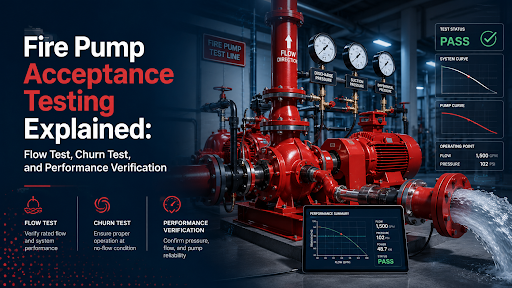
A fire pump that fails during an emergency is a critical liability. Acceptance testing exists to verify, before commissioning, that every component of the fire pump system performs to its rated specification under controlled conditions.
What Is Acceptance Testing and Why Is It Required?
Acceptance testing is a structured series of performance checks conducted on a newly installed fire pump system before handover. It verifies that the pump, driver, controller, and jockey pump each function correctly, individually and as an integrated system. Governing standards include NFPA 20 (installation of stationary pumps for fire protection) and NFPA 25 (inspection, testing, and maintenance of water-based systems).
The Churn Test
The churn test, also called the no-flow or shutoff test, measures pump pressure at zero discharge. The pump runs with the discharge valve closed, and the developed pressure is recorded. This establishes the shutoff head of the pump and is compared against the manufacturer’s published pump curve. For a Kirloskar fire pump, this data point is critical for verifying that the unit matches its rated performance envelope.
The Flow Test
The flow test evaluates pump performance across its operating range. Two key measurement points are:
- 100% rated flow — The pump’s nameplate discharge capacity at rated pressure
- 150% rated flow — The pump must deliver at least 65% of rated pressure at 150% of rated flow
At each point, pressure, flow rate, power consumption, and shaft RPM are measured and plotted against the manufacturer’s pump curve. Deviation beyond acceptable tolerances constitutes a test failure. Common failure reasons include worn impellers, incorrect rotation direction, air entrainment in suction piping, inadequate suction head, or an undersized power supply to the driver.
Performance Verification and Documentation
Test results must be formally documented on standardised acceptance test forms, signed by the testing authority, and retained for the asset’s lifecycle. Documentation typically includes pump curve comparison data, electrical readings, suction and discharge pressures, and controller function verification.
Best Practices
Ensure an adequate water supply is available for full-flow testing. Engage a qualified fire protection engineer to witness the test. Verify that the Kirloskar fire pump controller, including auto-start, manual start, and alarm functions, is fully tested before sign-off.
VEMPL has over 77 years of expertise in industrial pumping systems and supports performance verification for Kirloskar fire pump systems before commissioning. For more details, contact us on +918976951701, +919819907445, 02243117133 or email marketing@vemc.co.in.
FAQs
1. Is fire pump acceptance testing legally mandatory in India?
Acceptance testing is mandated under NBC (National Building Code) provisions and local fire authority NOC requirements.
2. What is the difference between the churn test and the flow test?
The churn test measures shutoff pressure at zero flow; the flow test evaluates pump performance across its rated operating range, including at 100% and 150% of rated capacity.
3. Which components are tested during acceptance testing?
The fire pump, its driver, the pump controller, and the jockey pump are all individually verified during an acceptance test.
4. How often must a fire pump be tested after commissioning?
NFPA 25 requires annual performance testing, with weekly or monthly no-flow (churn) tests depending on pump type.