
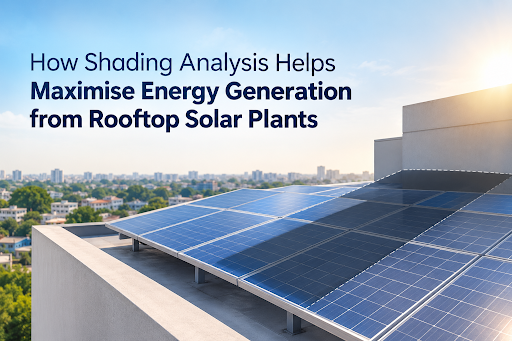
A rooftop solar plant can look perfect on paper and still fall short once it starts running. Often, the reason is shade nobody studied during design. That is why leading solar EPC companies in india (Engineering, Procurement and Construction firms) begin with a shading analysis.
What Is Shading Analysis and Why Does It Matter?
Shading analysis maps how shadows move across your roof through the day and the seasons, using site measurements and simulation. It matters because panels are wired together, so shade on one small patch can affect many panels.
Common Shading Sources on Rooftops
Common culprits include:
- Parapet walls and lift machine rooms
- Water tanks, air-conditioning units and ducts
- Neighbouring buildings and tall trees
- Antennas, railings and other rows of panels
Some shadows last for hours in winter, when the sun sits lower.
Impact on Generation, Strings and Inverter Performance
Panels are connected in a chain called a string. When one panel is shaded, the current of the whole string can drop, much like a kinked hosepipe. The shaded panel may also heat up and wear faster. The inverter, which converts solar power into usable electricity, then receives uneven input, and its Maximum Power Point Tracking (MPPT) feature, which finds the best operating level, struggles to settle. Generation falls and the equipment works harder.
Module Layout, Orientation and Row Spacing
Good design works around shade. Group shaded and sunlit panels should sit on separate strings. Orientation and tilt should follow the sun’s path, not just the roof slope.
Row spacing needs careful planning: rows placed too close together can shade one another in the early morning and late afternoon , while rows too far apart waste valuable roof space.
How Proper Design Improves Annual Energy Yield
Once shadows are mapped, designers can avoid weak spots, fine-tune the layout and match strings to the inverter. The daily gain looks small, but it adds up over the 25 years or more that monocrystalline panels last.
String-level remote monitoring, as offered by VEMPL, also spots shading losses early.
Practical Site-Assessment Considerations
A careful site visit makes the analysis reliable. Keep these points in mind:
- Visit at different times of day and note the sun’s seasonal path
- Measure the height of parapets, tanks and nearby buildings
- Check for future construction or tree growth
- Mark usable roof area, access paths and structural strength
This is why every VEMPL project begins with a site assessment and feasibility study.
Shading is easy to fix at the design stage and costly later. As one of the dependable solar EPC companies in Mumbai, VEMPL plans every rooftop plant around real site conditions.
VEMPL has over 77 years of expertise in electromechanical engineering solutions and industrial pumps offered by leading water pump manufacturers. Reach out to us on +91-8976951701, +91-9987099448, 022-43117133, or email marketing@vempl.co.in.
FAQs (Frequently Asked Questions)
1. What is shading analysis in solar projects?
A study that predicts how shadows will fall on a roof through the day and year.
2. Can a small shadow really reduce output?
Yes, because shade on one panel can pull down the performance of its entire string.
3. When should shading analysis be done?
Before the design is finalised, ideally during the initial site assessment.
4. Why does row spacing matter?
Closely spaced rows shade one another, while very wide spacing wastes roof space.
5. Can monitoring reveal shading losses?
Yes, string-level monitoring highlights underperforming sections early.