
When a fire breaks out, the pump system has one job: deliver water at the right pressure, every time. How that system is built and installed decides how quickly it goes live and how easy it is to look after.
What are Skid Mounted and Conventional Systems?
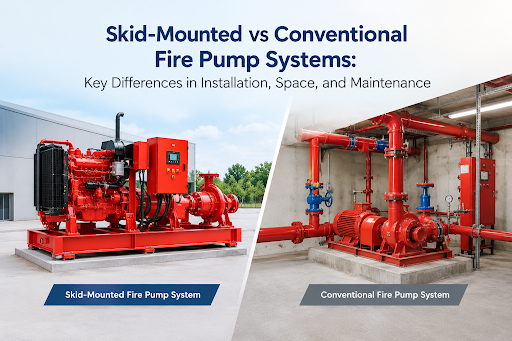
A conventional system is assembled on site. The pump, motor or diesel engine, piping, valves and controller arrive separately and are fitted together in the pump room. A skid-mounted system is a packaged unit, with the pump, driver, jockey pump and controls on one steel frame, built and tested at the factory. A Kirloskar fire pump can be supplied either way, depending on your project.
Installation, Foundation and Alignment
Conventional systems need a separate foundation for each pump and motor, followed by levelling, grouting and shaft alignment at site. The result depends heavily on local workmanship. A skid arrives pre-aligned on a rigid base, so it usually needs only a flat, level plinth. As one manufacturer notes, a pre-assembled unit leaves only pipe and power connections to complete.
Space and Installation Time
Skids are compact and can be sized to fit the available area, which helps in tight plant rooms. Conventional layouts need more floor space for site fabrication. Since most of the work happens in the factory, skid installation is usually quicker, while conventional work can stretch across several trades.
Testing and Commissioning
With a skid, the pump, driver and controller are tested together before dispatch, so site commissioning focuses on flow checks and handover. In a conventional system, testing starts only after on-site assembly, so problems surface late, when fixes cost more time.
Maintenance Accessibility
Skids keep valves, gauges and the controller within easy reach in a defined footprint. Conventional rooms can offer more working space around large pumps, which some teams prefer for major overhauls.
Why Factory Assembly Matters
Factory conditions allow tighter control over alignment, piping and wiring, plus a documented test record. Kirloskar Brothers Limited states that its fire pump sets are factory assembled and tested as per the National Building Code (NBC) and IS (Indian Standards).
Standards to Keep in Mind
NBC Part 4 expects an electric main pump, a diesel standby of the same capacity and a jockey pump. NFPA 20 (National Fire Protection Association, USA) covers installation of stationary fire pumps, and many projects also seek FM (Factory Mutual) approval and UL (Underwriters Laboratories) listing. Your consultant and local fire authority will confirm what applies.
Choosing the Right System
Weigh up these factors:
- Available space and pump room access
- Project timeline and site skills
- Budget and future expansion
- Compliance and audit requirements
Skids suit retrofits, tight sites and fast-track projects. Conventional layouts suit large pump rooms with custom designs. Authorised Kirloskar fire fighting pump dealers can match the system to your building.
VEMPL has over 77 years of expertise in electromechanical engineering solutions and industrial pumps offered by leading water pump manufacturers. Reach out to us on +91-8976951701, +91-9987099448, 022-43117133, or email marketing@vempl.co.in.
FAQs (Frequently Asked Questions)
1. Is a skid mounted system quicker to install?
Usually, as most assembly happens in the factory.
2. Can skids be used in basements?
Yes, their compact size suits tight rooms.
3. Do both types follow NFPA 20?
Yes, if designed and installed accordingly.
4. Which is easier to maintain?
Skids offer compact access; conventional rooms offer more space.
5. Does a skid need a foundation?
Yes, but only a simple level plinth.