
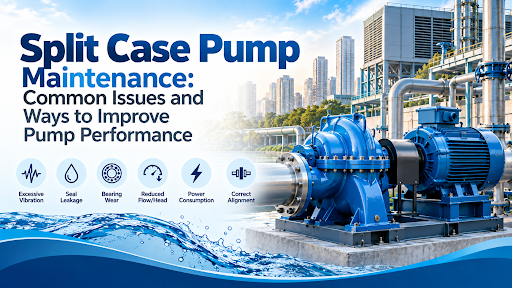
Split case pumps are widely used where dependable water movement, high flow rates and reliable continuous operation are important. They are commonly found in HVAC systems, water supply, cooling systems, industrial utilities, irrigation, dewatering and firefighting applications.
Selecting the right pump is only the beginning. Maintaining the equipment in good operating condition is equally important for reliable performance throughout its service life. Over time, vibration, bearing wear, mechanical seal leakage, misalignment and changes in operating conditions can affect performance. If these signs are not identified early, they can result in increased downtime, higher maintenance costs and reduced pumping efficiency.
A structured maintenance programme is therefore important for both new and existing installations.
What Is a Split Case Pump?
A split case pump is a centrifugal pump in which the casing is divided axially. This construction provides access to the internal rotating assembly for inspection and maintenance, making the design suitable for applications where periodic inspection, servicing or overhaul may be required.
VEMPL offers Kirloskar split case pumps for a range of water and industrial applications, including the i-HT, DSM/DSMT and UP series. Selection depends on the required flow, head, fluid characteristics, operating conditions and application.
Typical Applications
- Water supply systems
- Primary and secondary HVAC systems
- Cooling tower circulation
- Industrial utility water
- Irrigation
- Dewatering
- Firefighting
- Mine drainage
- Power plants
- Process and industrial applications
Why Maintenance Matters & Common Problems
Why Is Maintenance Important?
A pump can continue operating even when its performance has gradually deteriorated. It may still be running while delivering lower flow, developing increased vibration or consuming more power than before. Regular maintenance helps identify these changes before they become major problems.
Key Benefits of Maintenance
- Maintains pump performance by inspecting hydraulic and mechanical components so the pump can continue to perform according to its intended duty.
- Reduces unplanned downtime by identifying bearing wear, seal leakage, abnormal vibration and other developing issues early.
- Protects critical components through correct alignment, lubrication and timely replacement of worn parts, helping protect bearings, seals and couplings.
- Helps control operating costs because unsuitable operating conditions can increase energy use or accelerate wear.
- Extends equipment service life through preventive and condition-based maintenance.
Common Split Case Pump Problems
- Excessive Vibration
Excessive or increasing vibration is an important warning sign. Possible causes include pump and motor misalignment, bearing wear, coupling problems, unbalanced rotating components, foundation or mounting issues, pipe strain, hydraulic operating conditions and operation away from the intended duty point. A change from the pump’s normal vibration behaviour should be investigated rather than treated simply as normal ageing.
- Mechanical Seal Leakage
Mechanical seals help prevent leakage along the rotating shaft. Leakage can result from seal wear, incorrect installation, shaft or sleeve damage, misalignment, unsuitable operating conditions or contamination in the pumped fluid. Replacement seals should be selected according to the specific pump model and operating conditions.
Common Problems: Bearings, Flow, Power & Alignment
- Bearing Wear or Overheating
Bearings support the rotating assembly and are essential to smooth pump operation. Bearing problems may be associated with incorrect, insufficient or excessive lubrication, bearing wear, misalignment, excessive vibration or contamination. Bearing temperature and vibration should be monitored as part of routine maintenance.
- Reduced Flow or Head
A pump delivering less flow or pressure than expected does not necessarily mean the pump itself has failed. Possible causes include changes in system resistance, blocked suction or discharge piping, incorrect valve position, air entering the suction system, impeller wear or damage, incorrect rotation, changed system requirements or operation away from the intended duty.
The complete pumping system should be evaluated before deciding that internal pump components need replacement.
- Increased Power Consumption
An increase in motor current or power consumption can indicate a change in pump operating conditions. Possible causes include operation at a different flow condition, increased system resistance, mechanical friction, bearing problems, impeller-related issues or changes in fluid conditions. Comparing current readings with historical operating data can help identify gradual changes in performance.
- Coupling and Alignment Problems
Correct alignment between the pump and motor is important for reliable operation. Misalignment can contribute to increased vibration, coupling wear, bearing loading, mechanical seal problems and premature component wear. Alignment should be checked during commissioning and after relevant maintenance activities.
Improving Performance: Start With Actual Operating Data
Maintaining a split case pump is not only about replacing worn components. It also requires understanding how the pump is actually operating. Important parameters include flow, suction pressure, discharge pressure, motor current, power consumption, bearing temperature and vibration. Recording these values periodically makes it easier to identify deviations from normal operation.
How to Improve Pump Performance
- Check the Actual Duty Point
A pump should operate according to the requirements for which it was selected. If system requirements have changed after installation, the pump may no longer be operating under the same conditions. Changes in building demand, production requirements, piping, valves or overall system configuration can influence pump operation.
- Maintain Correct Alignment
Pump and motor alignment should be checked using an appropriate procedure. This is particularly important after pump maintenance, coupling replacement, motor replacement, equipment movement or a major overhaul. Correct alignment can help reduce unnecessary mechanical loading and vibration.
- Follow the Correct Lubrication Procedure
Bearings should be lubricated according to the manufacturer’s recommendations. Adding more lubricant does not necessarily improve bearing performance. Both insufficient and excessive lubrication can create problems.
- Inspect Hydraulic Components
During scheduled maintenance, components such as the impeller and wear-related components should be inspected for wear, corrosion, erosion, deposits and damage. Their condition can influence hydraulic performance.
- Investigate Problems Before Replacing Components
A common maintenance mistake is replacing a damaged component without identifying why it failed. For example, repeatedly replacing a mechanical seal without checking alignment or operating conditions may not solve the underlying problem. Maintenance assessment should therefore focus on root-cause identification.
How Kirloskar Designs Support Maintenance
The construction of a split case pump can influence maintenance requirements. VEMPL’s Kirloskar i-HT range uses an axially split case construction and is described as having a maintenance-friendly design.
Kirloskar i-HT Split Case Pump
- Externally removable bearing housing
- Mechanical seal arrangement
- Impeller nut and sleeve arrangement
- Easy wear ring fitment
- Double-suction impeller arrangement for single-stage models
The i-HT range is available for HVAC, high-pressure boosting, cooling towers, industrial utility water, dewatering, water supply and other industrial applications.
Kirloskar Ranges & Maintenance Checklist
Kirloskar DSM/DSMT Split Case Pump
The DSM/DSMT range uses a horizontally mounted, axially split casing and two-stage construction. A key maintenance advantage is that the rotating unit can be removed without disturbing connected pipework and alignment. This can simplify maintenance where minimising disruption is important.
Kirloskar UP Split Case Pump
The UP series is another horizontal split casing pump range available from VEMPL, with large flow and head capabilities for demanding water and industrial applications. The range is listed with capacities up to 40,000 m³/hr and heads up to 220 metres, with selection dependent on actual application requirements.
Split Case Pump Maintenance Checklist
During Routine Inspection
- Abnormal noise
- Increased vibration
- Leakage
- Bearing temperature
- Coupling condition
- Pump and motor condition
- Suction and discharge pressure
- Flow
- Motor current or power consumption
During Periodic Maintenance
- Bearings
- Mechanical seals
- Couplings
- Shaft and sleeves
- Impeller
- Wear components
- Gaskets
- Lubrication
- Alignment
- Foundation and mounting
- Motor condition
The exact maintenance procedure and intervals should follow the manufacturer’s recommendations and the operating conditions of the installation.
When Should a Pump Be Serviced?
There is no single maintenance interval for every pump. Frequency depends on the pump model, operating hours, application, fluid characteristics, duty conditions, environmental conditions, criticality of the installation, manufacturer recommendations and previous maintenance history.
Spares, Support & Pump Selection
When to Inspect Beyond Scheduled Maintenance
Apart from scheduled maintenance, the pump should be inspected whenever there is a noticeable change in flow, head or pressure, vibration, noise, bearing temperature, leakage, motor current or power consumption.
Split Case Pump Spares: Why the Right Components Matter
Maintenance quality also depends on using the correct replacement components. Depending on the pump model and maintenance requirement, commonly serviced components can include mechanical seals, bearings, couplings, shafts and sleeves, wear rings or other wear components, gaskets and impeller-related components.
Using genuine OEM pump spares matched to the specific pump model helps ensure that replacement components are appropriate for the equipment. VEMPL supports customers with genuine OEM pump spares as part of its broader pumping solutions and after-sales support.
VEMPL Support for Kirloskar Split Case Pumps
VEMPL is an Authorized Channel Partner of Kirloskar Brothers Limited (KBL) and supports customers across pump selection, supply and after-sales requirements.
- Application-based pump selection
- Flow and head evaluation
- Pump sizing guidance
- Kirloskar split case pump supply
- Genuine OEM pump spares
- Maintenance and servicing support
- AMC support
- Installation supervision
- Commissioning and start-up support
- Replacement and retrofit guidance
- Technical support for existing installations
This approach allows customers to look beyond the initial pump purchase and consider the complete operating lifecycle.
How to Select the Right Pump
Maintenance starts before installation. Selection should consider flow requirement, head requirement, fluid characteristics, operating pattern, installation conditions and maintenance requirements. For critical installations, ease of inspection, availability of spares and after-sales support should be considered during selection.
Maintenance Mistakes, Conclusion & FAQs
Common Maintenance Mistakes to Avoid
Ignoring changes in vibration: A gradual increase can indicate a developing mechanical or hydraulic problem.
Replacing parts without finding the cause: Replacing a bearing, seal or coupling without investigating the reason for failure can lead to repeated problems.
Incorrect lubrication: More lubricant does not necessarily mean better lubrication; manufacturer recommendations should be followed.
Neglecting alignment: Alignment should be checked after relevant maintenance work and whenever operating conditions indicate a possible problem.
Using incorrect spares: Replacement components should match the specific pump model and application.
Looking only at the pump: Performance is influenced by the complete hydraulic system, including suction conditions, valves, piping and system demand.
Conclusion
A split case pump is often selected for applications where reliable, high-capacity pumping is important. Long-term performance, however, depends on more than the initial pump selection. Regular inspection, correct alignment, appropriate lubrication, timely replacement of worn components and monitoring of operating parameters can help maintain pump performance and reduce unexpected downtime.
Kirloskar’s split case pump range available through VEMPL includes the i-HT, DSM/DSMT and UP series, covering different flow, head and application requirements. Their construction and application-specific features can also support practical maintenance requirements.
For an existing pump, maintenance should begin with understanding the actual problem rather than simply replacing components. Whether selecting a new pump or improving an existing installation, VEMPL can help evaluate the application, recommend the appropriate Kirloskar solution and support the equipment through its operating lifecycle.
Frequently Asked Questions
1. What are the common problems?
Common issues include excessive vibration, bearing wear, mechanical seal leakage, coupling misalignment, reduced flow or head and increased power consumption.
2. Why are these pumps considered maintenance-friendly?
Their axially split casing provides access to the internal rotating assembly. Depending on the design, this can make inspection and maintenance more convenient. Kirloskar DSM/DSMT pumps, for example, allow the rotating unit to be removed without disturbing pipe connections and alignment.
3. What ranges does VEMPL offer?
VEMPL offers Kirloskar i-HT, DSM/DSMT and UP ranges, with selection based on application flow, head and operating requirements.
4. How can performance be improved?
Start by checking actual flow, pressure, vibration, temperature and power consumption. Alignment, lubrication, hydraulic components and system operating conditions should then be evaluated.
5. Does VEMPL provide spares and support?
Yes. VEMPL supports customers with genuine OEM pump spares, technical and after-sales support, maintenance, servicing, AMC, installation supervision, commissioning, replacement and retrofit guidance, depending on the pump and application.
Need Help With Your Pump?
If the pump is experiencing reduced flow, increased vibration, seal leakage, bearing issues or higher power consumption, share the pump model and operating details with VEMPL’s technical team.
VEMPL – Authorized Channel Partner of Kirloskar Brothers Limited (KBL)
Call: +91-9987099448 | Email: marketing@vempl.co.in