
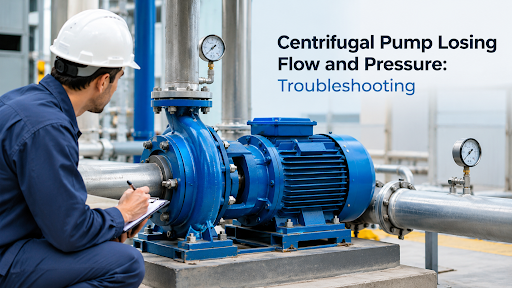
Centrifugal pumps are designed to deliver a specific flow at a defined head and pressure. When actual performance falls below expectations, the cause may be anything from a blocked suction line to impeller wear or incorrect pump selection. Understanding the difference between flow, head and pressure is the first step towards effective troubleshooting.
Flow is the volume of liquid moved by the pump per unit of time, usually expressed in m³/h or L/min. Head represents the energy added to the liquid by the pump and is expressed in metres of liquid. Pressure is the force exerted by the liquid and is often measured in bar or Pa. Pump head and pressure are related, but head remains a key parameter when evaluating pump performance.
Common Causes of Low Flow and Pressure
1. Suction Blockage
A clogged strainer, partially closed suction valve or restricted suction pipe can limit the liquid entering the pump.
Field check: Inspect the suction line, strainer and valves. Compare suction pressure with normal operating readings.
Troubleshooting: Remove blockages, clean strainers and ensure valves are fully open.
2. Air Ingress
Air entering through loose flanges, seals or suction pipe joints can interrupt smooth pumping and reduce flow.
Field check: Inspect suction-side connections and look for unstable pressure, vibration or irregular discharge.
Troubleshooting: Tighten connections and replace damaged seals or gaskets.
3. Cavitation
Insufficient suction pressure can cause liquid to vaporise inside the pump, resulting in noise, vibration and fluctuating flow.
Field check: Check suction pressure and compare available NPSH with the pump requirement.
Troubleshooting: Reduce suction restrictions, improve liquid supply conditions and ensure the pump operates within its design parameters.
4. Impeller Wear or Damage
Erosion, corrosion, blockage or excessive wear can reduce the impeller’s ability to transfer energy to the liquid.
Field check: Inspect the impeller during maintenance and compare performance against the pump curve.
Troubleshooting: Clean, repair or replace the impeller as required.
5. Incorrect Rotation
If the motor rotates in the wrong direction, the pump may deliver significantly reduced flow and pressure.
Field check: Verify motor rotation against the manufacturer’s specified direction.
Troubleshooting: Correct the motor connections after isolating the equipment and following electrical safety procedures.
6. Discharge Restrictions
A partially closed discharge valve, blocked pipeline or excessive system resistance can alter the operating point.
Field check: Check valve positions, discharge pressure and pipeline condition.
Troubleshooting: Remove restrictions and verify that the system resistance matches the design conditions.
Check the Pump Curve and BEP
Every centrifugal pump has a performance curve showing the relationship between flow, head and efficiency. The Best Efficiency Point (BEP) represents the operating region where the pump achieves its intended hydraulic efficiency.
Operating significantly away from BEP can increase vibration, recirculation, energy consumption and component wear. If actual system demand does not match the pump curve, the issue may require system correction or pump selection review rather than component replacement.
Select and Maintain the Right Pump
Correct pump selection should consider required flow, head, liquid properties, system resistance and operating conditions. A correctly selected split case pump, for example, can be suitable for high-flow, continuous-duty water handling applications. VEMPL offers split case pump solutions with horizontally split casings designed for easier inspection and maintenance.
Routine maintenance should include checking suction and discharge conditions, inspecting valves and strainers, monitoring vibration and pressure, checking alignment and examining impeller and wear components at appropriate intervals. For persistent performance loss, professional inspection can help determine whether servicing, component replacement or pump refurbishment is required.
Connect with VEMPL for reliable pump solutions designed to meet your requirements at +91-8976951701, +91-9987099448, 022-43117133, or email marketing@vempl.co.in.
Frequently Asked Questions
Q1. Why Is My Pump Running but Not Delivering Enough Water?
Common causes include suction restrictions, air ingress, cavitation, impeller damage, incorrect rotation and discharge restrictions.
Q2. How Do I Know if a Pump Is Cavitating?
Typical signs include unusual noise, vibration, fluctuating flow and unstable pressure. Suction conditions and NPSH should be checked against the pump’s requirements.
Q3. Why Is Pump Pressure Normal but Flow Low?
A restriction in the discharge system, incorrect system resistance or operation away from the intended point on the pump curve can result in low flow despite pressure readings appearing normal.
Q4. When Should a Pump Be Serviced?
Persistent loss of flow or pressure, excessive vibration, abnormal noise, leakage or increased energy consumption can indicate the need for inspection and servicing.
Q5. How Can I Choose the Right Pump?
Start with the required flow, head, liquid characteristics, system conditions and operating range. The pump should then be selected to operate within an appropriate region of its performance curve, preferably near its BEP.
Q6. Need the Right Pump for Your Application?
Connect with VEMPL to discuss your flow, pressure and application requirements and find the right split case pump for your system.