
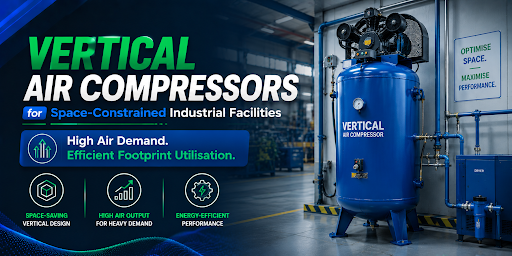
Floor space is a finite and costly resource in manufacturing environments. When compressed air demand is high, but the installation area is limited, compressor orientation becomes a critical decision. Vertical air compressors, such as the ELGi LD Series, address this challenge by stacking the receiver and compressor unit upright, significantly reducing the floor area occupied compared to horizontal equivalents.
Vertical versus Horizontal Design
Horizontal compressors lay the receiver tank along a horizontal axis, requiring lateral clearance on multiple sides. Vertical units orient the tank upright, concentrating the installation into a compact ground-level footprint. An authorised ELGi air compressor dealer in Mumbai can assess which configuration best suits a given facility layout.
Space Optimisation and Suitable Applications
A vertical compressor can be positioned in corners or along walls where horizontal units simply would not fit. The ELGi reciprocating compressor range in vertical configurations is well-suited to small manufacturing plants, workshops, and auxiliary production stations with intermittent-to-moderate air demand.
Performance, Sizing, and Duty Cycle
Single-stage vertical reciprocating compressors typically deliver up to 8–10 bar; two-stage models reach 15 bar or higher. Most are rated for a 50–75% duty cycle and should not be run continuously at full load. Correct sizing, based on a formal air demand audit, is essential. An experienced ELGi compressor dealer in Mumbai should review connected tool demand, required pressure, and duty cycle before specifying equipment.
Cooling, Ventilation, and Installation Safety
Ambient temperature at the air inlet should remain below 40°C, and hot exhaust air must dissipate freely. Maintenance access to cylinder heads, valves, and belt drives must be factored into installation planning. The receiver tank must carry a valid pressure vessel inspection certificate, and a calibrated safety relief valve is mandatory. The unit must be secured on a level, load-bearing surface to prevent instability.
Energy Efficiency
Reciprocating compressors generally have a higher specific power than rotary screw equivalents, making them most economical for lower-demand, intermittent-use applications. Within their operating envelope, however, they offer a cost-effective compressed air solution where capital budget rule out larger systems.
VEMPL has provided electromechanical engineering solutions in India for over 78 years. As an authorised partner for ELGi air compressor dealers in Mumbai, VEMC provides consultation, supply, installation, and after-sales support across manufacturing and process industries. Reach out to us on +91 8976951701, +91 9819907445, 022 43117133 or email us at marketing@vempl.co.in
FAQs
1. What is the key advantage of a vertical compressor over a horizontal one?
Vertical compressors occupy a significantly smaller floor footprint by orienting the receiver tank upright, making them ideal for space-constrained facilities.
2: What ventilation is needed for an indoor vertical compressor installation?
The unit requires unobstructed airflow, ambient inlet temperature below 40°C, and, in enclosed rooms, forced extraction to prevent heat buildup.
3: How do I size a vertical compressor correctly?
Calculate total connected air demand, add a 25–30% buffer for future load, and verify required delivery pressure.
4: What routine maintenance does a vertical reciprocating compressor require?
Key tasks include checking crankcase oil, inspecting and replacing valves, changing the air filter, draining the receiver, and verifying belt tension.