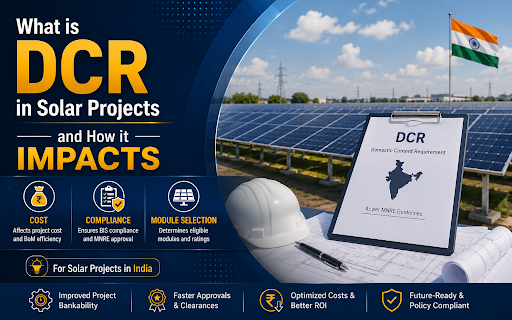
DCR, or Domestic Content Requirement, is a key rule in Indian solar projects that requires the use of domestically manufactured solar cells and modules in specific schemes and government-backed installations. For project owners and solar EPC companies in India, it directly affects compliance, procurement choices, and total project cost.
DCR and Regulatory Background
DCR was introduced to support India’s solar manufacturing ecosystem and reduce dependence on imports. In practice, it applies to selected government-supported projects and programmes, where modules must meet domestic content rules and be traceable through the DCR Verification Portal. MNRE’s ALMM, or Approved List of Models and Manufacturers, also plays a major role because only listed modules are eligible for many government and government-assisted projects.
DCR vs non-DCR
DCR projects use solar PV modules made from domestically produced cells and modules, while non-DCR projects can use imported or non-domestic modules, subject to the project category and current rules. This difference matters because DCR is not just a sourcing choice, it is a compliance requirement in the right project category. For many private projects, non-DCR modules remain a practical option when the project does not fall under mandated schemes.
ALMM and Procurement
From a procurement angle, ALMM is now one of the first checks before finalising modules. For government, government-assisted, and several regulated project types, only ALMM-listed modules are permitted. Recent MNRE updates also show that solar PV cells are moving under tighter ALMM controls from 1 June 2026, which makes sourcing discipline even more important for solar EPC services.
Cost and Feasibility
DCR modules often cost more than imported alternatives because domestic manufacturing capacity, supply depth, and pricing can differ. That can push increase CAPEX and affect payback, especially for up CAPEX and affect payback, especially on large rooftops and utility-scale projects. For this reason, teams usually compare compliance needs, budget, and delivery timelines before recommending a module route.
Where DCR Applies
DCR is most relevant in government schemes, subsidised projects, and certain public procurement routes. Private commercial and industrial projects may have more flexibility, but they still need to follow the applicable ALMM and bidding rules. So, the project type should be checked early, not after design freeze.
Compliance Risks and Documents
The main risk is buying the wrong module and discovering later that it cannot be used for the project category. Teams should verify ALMM status, DCR certificates, invoices, serial numbers, and portal records before dispatching and installation. For solar EPC companies in Mumbai and across India, good documentation is just as important as good hardware.
Outlook in India
India is clearly moving towards stronger domestic sourcing and tighter verification. That means DCR and ALMM will likely stay central to project planning, especially where public funding, net-metering, or open access rules apply. For buyers comparing solar EPC companies in India, the real value now lies in selecting a partner who can balance compliance, cost, and supply certainty.
As a trusted solar EPC company in Mumbai, VEMPL combines rigorous engineering, high-quality components, and operational considerations to maximise performance ratio and ROI. To discuss your project, contact us on +91 8976951701, +91 9819907445, 022 43117133, or email marketing@vemc.co.in.
Frequently Asked Questions (FAQs)
1. What does DCR mean in solar?
DCR means Domestic Content Requirement, which calls for domestically manufactured solar cells and modules in certain projects.
2. Is DCR mandatory for all solar projects in India?
No. It mainly applies to specific government-backed or regulated project categories.
3. What is the difference between DCR and ALMM?
DCR is domestic content, while ALMM is the approved list of eligible models and manufacturers for use in covered projects.
4. Does DCR increase project cost?
Often, yes, because domestic modules can cost more, and availability can affect procurement planning.
5. Why should EPC teams care about DCR compliance?
Because non-compliant modules can delay approvals, create rejection risks, and impact project execution.
VEMPL’s VEMCO Solar division supports compliant, practical solar EPC services for businesses looking for a trusted solar EPC company in Mumbai.
Conclusion
Understanding the Domestic Content Requirement (DCR) is essential for businesses planning solar projects in India, especially when participating in government-backed schemes and tenders. DCR influences module selection, project costs, regulatory compliance, and long-term procurement strategies, making it a key consideration during project planning.
By evaluating your project requirements and partnering with an experienced solar EPC provider, you can ensure compliance while optimizing performance and return on investment. If you’re looking for expert guidance on DCR-compliant solar projects, VEMPL is a trusted partner, offering end-to-end solar EPC solutions, technical expertise, and reliable project execution tailored to your business needs.