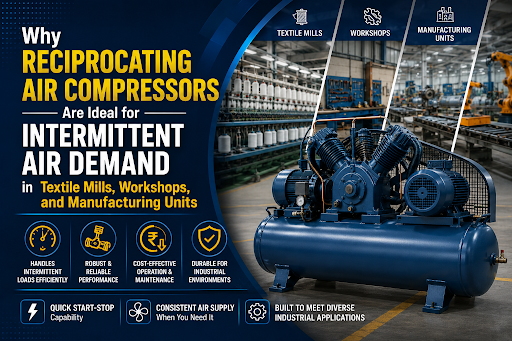
Compressed air requirements vary significantly across industries. While some facilities require a constant supply of compressed air, many manufacturing environments operate with intermittent demand patterns. In such cases, a reciprocating air compressor often proves to be the most practical and cost-effective solution.
As experienced air compressor dealers in Mumbai, we frequently recommend reciprocating compressors for applications where air consumption fluctuates throughout the day.
Understanding Intermittent vs Continuous Air Demand
Intermittent air demand occurs when compressed air is used in cycles rather than continuously. Equipment may operate for a few minutes before remaining idle for extended periods.
This is common in textile mills, automotive workshops, fabrication units, and MSMEs where pneumatic tools, cleaning operations, or production equipment are used only when required. In contrast, continuous demand applications require a constant flow of compressed air throughout the production cycle.
How Reciprocating Compressors Work
A reciprocating air compressor uses a piston moving inside a cylinder to compress air. The piston draws atmospheric air into the cylinder during the suction stroke and compresses it during the discharge stroke before delivering it to the receiver tank.
This simple yet robust design allows the compressor to efficiently handle varying demand conditions without compromising performance.
Load and Unload Efficiency During Low Demand
One of the biggest advantages of reciprocating compressors is their ability to operate efficiently under fluctuating loads. When air demand decreases, and the receiver tank reaches the desired pressure, the compressor automatically unloads or stops.
This prevents unnecessary energy consumption during idle periods and allows the system to restart only when additional compressed air is required.
Energy Savings in Intermittent Operations
Because the compressor runs only when needed, energy consumption remains closely aligned with actual air demand. This makes reciprocating compressors particularly economical for facilities with frequent start-stop operations.
For businesses seeking to reduce operating costs without sacrificing performance, this efficiency can result in meaningful long-term savings.
Suitable Pressure and Flow Requirements
Reciprocating compressors are well-suited for applications requiring moderate airflow and relatively high pressures. They can comfortably support pneumatic tools, cleaning systems, packaging equipment, textile machinery, and maintenance operations commonly found in industrial environments.
Industry Applications
Textile mills use compressed air for automation, cleaning, and process equipment. Automotive workshops rely on compressed air for impact wrenches, spray painting, and tyre servicing. Small and medium manufacturing units often require compressed air for machine operation, assembly processes, and maintenance tasks.
In all these environments, demand tends to fluctuate, making reciprocating compressors a practical choice.
Maintenance and Lifecycle Cost
Reciprocating compressors are known for their straightforward design and ease of maintenance. Routine servicing, such as filter replacement, lubrication, and inspection, can help ensure reliable operation for many years.
The lower initial investment, combined with manageable maintenance requirements, often results in an attractive lifecycle cost.
Reciprocating vs Screw Compressors
While screw compressors are excellent for continuous-duty applications, they may not always be the most efficient option for facilities with intermittent air usage. Reciprocating compressors generally deliver better economics when compressed air demand is irregular.
For businesses evaluating compressed air solutions, consulting an experienced air compressor dealer or a trusted ELGi air compressor dealer can help determine the most suitable system for specific operational requirements.
When air demand is intermittent rather than constant, a reciprocating air compressor offers the ideal combination of performance, energy efficiency, reliability, and cost effectiveness.
VEMPL’s experts can help you select the most efficient and reliable system for your application. Contact us at +91 8976951701, +91 9819907445, 022 43117133, or email marketing@vemc.co.in to discuss your requirements.
FAQs
1. What is a reciprocating air compressor best suited for?
It is ideal for applications with intermittent or fluctuating compressed air demand, such as workshops, textile mills, and MSMEs.
2. Are reciprocating compressors energy efficient?
Yes. They consume power only when compressed air is required, helping reduce energy costs during low-demand periods.
3. How do reciprocating compressors compare with screw compressors?
Reciprocating compressors are generally more economical for intermittent use, while screw compressors are better suited for continuous operation.
4. Do reciprocating air compressors require high maintenance?
No. With regular servicing and proper upkeep, they offer reliable performance and a cost-effective operating life.
Conclusion
Reciprocating air compressors are an excellent choice for applications with intermittent air demand, delivering reliable performance, energy efficiency, and cost-effective operation across textile mills, workshops, and manufacturing units. Their ability to provide compressed air on demand while minimizing energy consumption makes them well-suited for facilities with fluctuating production requirements.
Choosing the right compressor and partnering with a trusted supplier are essential for maximizing equipment performance and long-term reliability. If you’re looking for high-quality reciprocating air compressors backed by expert technical support, VEMPL is an excellent choice, offering genuine solutions, professional guidance, and dependable after-sales service tailored to your industrial needs.