
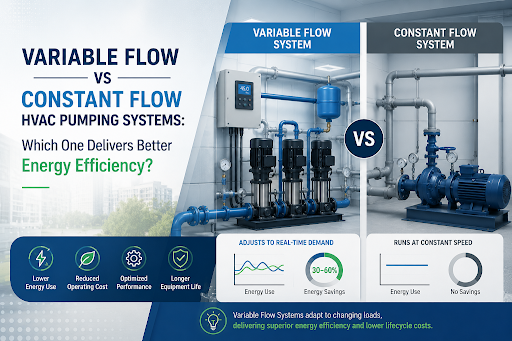
Heating, Ventilation, and Air Conditioning (HVAC) pumping systems circulate chilled or hot water to keep buildings comfortable. The pumping method you choose directly affects energy bills, so understanding constant flow and variable flow systems matters before you invest.
Constant Flow System Explained
A constant flow system runs the pump at a fixed speed at all times. Water circulates at the same rate regardless of actual cooling or heating demand, with control valves throttling flow to manage temperature. This simplicity makes it reliable, but it wastes energy when demand drops.
Variable Flow System Explained
A variable flow system adjusts pump speed to match real-time demand. A Variable Frequency Drive (VFD) slows or speeds up the motor, while control valves and sensors continuously track temperature and pressure to fine-tune flow. This working principle means the pump only works as hard as it needs to.
Comparison at a Glance
Energy consumption: constant flow wastes energy at part load; variable flow saves substantially. Initial investment: constant flow is cheaper upfront; variable flow costs more due to VFDs and sensors. Maintenance: constant flow needs less monitoring; variable flow needs periodic VFD checks. Flexibility: variable flow adapts to load changes; constant flow does not. Operating cost: variable flow wins over the system’s lifetime.
The Affinity Laws explain why variable flow saves so much. Reducing pump speed cuts flow proportionally, but power drops by the cube of that reduction. Even a modest speed cut delivers a large saving, which matters in HVAC systems where load varies through the day and across seasons.
When to Choose Which
Constant flow suits smaller buildings with steady, predictable loads and tighter budgets. Variable flow is recommended for larger buildings, hospitals, and offices with fluctuating occupancy, where energy savings justify the added investment. Most projects recover the extra cost through lower electricity bills within two to four years, depending on operating hours and local tariffs.
Impact on Building Efficiency
Variable flow systems improve overall building energy performance and support green building certifications such as LEED and IGBC ratings, which reward efficient HVAC design. They also integrate smoothly with smart building automation, allowing pumps to respond to occupancy and weather data automatically.
A common misconception is that variable flow always guarantees savings. Poor VFD programming or incorrect sizing can undo the benefits, so correct design and commissioning matter as much as the technology itself. Retrofitting older constant flow systems with VFDs is often possible and can be a cost-effective way to modernise ageing HVAC installations without replacing the entire pump set.
As experienced industrial pump suppliers, VEMPL helps consultants and facility managers design pumping systems suited to actual building loads, balancing upfront cost against long-term efficiency.
VEMPL has over 77 years of expertise in electromechanical engineering solutions and industrial pumps offered by leading water pump manufacturers. Reach out to us on +91 8976951701, +91 9819907445, 022 43117133 or email marketing@vemc.co.in
Frequently Asked Questions (FAQs)
1. Which system saves more energy, constant flow or variable flow?
Variable flow saves significantly more energy, especially under fluctuating loads.
2. Is variable flow always the better choice?
Not always; small buildings with steady loads may not justify the extra cost.
3. Can I retrofit my existing constant flow system?
Yes, adding a VFD to an existing pump is usually possible and cost-effective.
4. How long does it take to recover the investment in variable flow?
Most buildings see payback within two to four years, depending on usage.
5. Does variable flow help with green building certifications?
Yes, it improves energy performance scores used in ratings like LEED and IGBC.