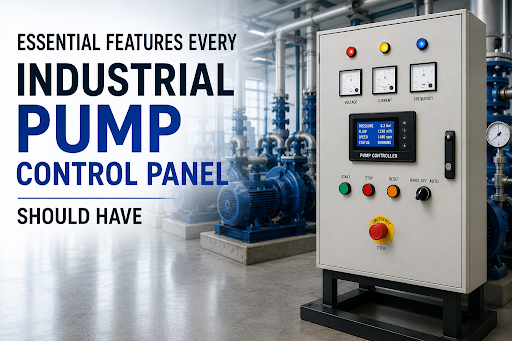
In any pumping system, the pump may be the most visible component, but the control panel is the brain behind the operation. Whether used in industrial manufacturing, water supply, HVAC systems, sewage treatment, fire protection, or commercial buildings, a well-designed pump control panel ensures that pumps operate safely, efficiently, and reliably.
Without an intelligent control panel, even the highest-quality pump can experience frequent breakdowns, higher energy consumption, and reduced service life due to improper operation or lack of protection.
Modern industrial facilities demand more than simple motor starters. Today’s pump control panels integrate advanced automation, real-time monitoring, Variable Frequency Drives (VFDs), PLCs, SCADA connectivity, and predictive diagnostics to improve operational efficiency while minimizing downtime.
If you’re evaluating control panel manufacturers in Mumbai, understanding the essential features of a modern industrial pump control panel will help you make an informed investment that delivers long-term reliability and performance.
What Is an Industrial Pump Control Panel?
An industrial pump control panel is an electrical control system that monitors, protects, and automates the operation of one or more pumps.
It acts as the central command center by:
- Starting and stopping pumps
- Protecting motors from electrical faults
- Maintaining system pressure or flow
- Monitoring operating conditions
- Controlling multiple pumps automatically
- Communicating with plant automation systems
A properly engineered control panel improves both equipment reliability and overall system efficiency.
Why Is a High-Quality Pump Control Panel Important?
A pump control panel does much more than switch a motor ON or OFF.
A well-designed panel helps:
- Improve operational safety
- Reduce electricity consumption
- Extend pump and motor life
- Minimize unplanned downtime
- Simplify maintenance
- Increase system reliability
- Enable intelligent automation
- Support remote monitoring
For industries operating continuously, these benefits translate into lower operating costs and improved productivity.
Essential Features Every Industrial Pump Control Panel Should Have
1. Intelligent Motor Protection
Motor protection is one of the most important functions of any control panel.
Industrial pumps are exposed to several electrical and mechanical risks that can cause expensive failures if not detected early.
A reliable control panel should protect against:
- Motor overload
- Phase failure
- Phase reversal
- Voltage imbalance
- Under-voltage and over-voltage
- Short circuits
- Dry running
- Earth faults
- Motor overheating
- Locked rotor conditions
These protective features help prevent costly equipment damage while improving system reliability.
2. Automatic Pump Operation
Automation minimizes manual intervention while ensuring the pumping system responds efficiently to changing operating conditions.
Modern control panels can automatically:
- Start and stop pumps
- Maintain constant pressure
- Maintain tank water levels
- Alternate duty and standby pumps
- Sequence multiple pumps based on demand
- Automatically switch to standby pumps during faults
Automatic operation reduces operator dependency while improving process consistency.
3. Variable Frequency Drive (VFD) Compatibility
Energy efficiency has become a major priority across industrial sectors.
Integrating a Variable Frequency Drive (VFD) allows the control panel to regulate pump speed according to actual system demand instead of running continuously at full speed.
Benefits include:
- Lower electricity consumption
- Soft motor starting
- Reduced inrush current
- Constant pressure control
- Reduced mechanical wear
- Longer pump life
- Lower maintenance costs
For systems with varying demand, VFD-based control panels can deliver significant energy savings.
4. PLC-Based Intelligent Control
Many modern pump control panels incorporate Programmable Logic Controllers (PLCs) to enable advanced automation.
PLC-based systems provide:
- Flexible programming
- Automated decision-making
- Multi-pump coordination
- Process control
- Alarm management
- Data logging
- Easy system expansion
They are particularly useful in large industrial plants where multiple pumps operate simultaneously.
5. Real-Time Monitoring and Diagnostics
Operators need continuous visibility into system performance.
A quality control panel should display real-time operating information such as:
- Pump status
- Motor current
- Voltage
- Frequency
- Pressure
- Flow rate (where applicable)
- Running hours
- Energy consumption
- Alarm history
- Fault indications
Real-time monitoring enables faster troubleshooting and better maintenance planning.
6. User-Friendly HMI (Human Machine Interface)
Modern control panels include an intuitive Human Machine Interface (HMI) that simplifies system operation.
Using an HMI, operators can:
- Monitor pump performance
- View live operating data
- Acknowledge alarms
- Adjust operating parameters
- Review historical trends
- Access maintenance information
- Perform diagnostics
A well-designed HMI improves usability while reducing operator training requirements.
7. Remote Monitoring and SCADA Integration
Industries increasingly require centralized monitoring of critical equipment.
Professional control panel manufacturers in Mumbai design panels that integrate seamlessly with:
- SCADA systems
- Building Management Systems (BMS)
- Distributed Control Systems (DCS)
- PLC networks
- Industrial IoT platforms
- Cloud-based monitoring solutions
Remote monitoring allows maintenance teams to detect issues early, reducing downtime and enabling predictive maintenance.
8. Reliable Electrical Components
The reliability of a control panel depends heavily on the quality of its internal components.
Look for panels built using industrial-grade:
- Contactors
- Motor protection relays
- MCCBs and MCBs
- PLCs
- VFDs
- Power supplies
- Control transformers
- Terminal blocks
- Wiring and cable management systems
Using high-quality components improves safety, reliability, and service life.
9. Alarm and Fault Management
An effective control panel should immediately alert operators when abnormal conditions occur.
Typical alarms include:
- Pump failure
- Low pressure
- High pressure
- Motor overload
- Dry run condition
- Phase loss
- Communication failure
- High temperature
Clear alarm notifications enable quicker corrective action and reduce system downtime.
10. Energy Monitoring and Optimization
Many modern facilities track energy consumption to improve operational efficiency.
Advanced pump control panels can provide:
- Power consumption data
- Energy usage trends
- Efficiency analysis
- Load balancing
- Pump performance monitoring
These insights help industries identify opportunities for energy savings and optimize pump operation.
11. Expandability for Future Requirements
As facilities grow, pumping requirements often change.
A well-designed control panel should support:
- Additional pumps
- Future sensors
- Extra communication modules
- Additional automation functions
- Software upgrades
Planning for expansion helps reduce future modification costs.
12. Compliance with Industry Standards
Always ensure the control panel complies with applicable electrical and industrial standards for safety, quality, and reliability.
Compliance provides:
- Improved operational safety
- Regulatory acceptance
- Reliable performance
- Easier maintenance
- Better long-term durability
Working with experienced manufacturers helps ensure panels are designed and tested according to recognized industry standards.
Industries That Use Industrial Pump Control Panels
Pump control panels are essential across a wide range of industries, including:
- Manufacturing plants
- Water supply systems
- Water and wastewater treatment plants
- Commercial buildings
- Hospitals
- Hotels
- HVAC systems
- Fire protection systems
- Power plants
- Pharmaceutical industries
- Chemical processing plants
- Food and beverage facilities
- Infrastructure projects
Each application requires customized control logic based on operational requirements.
How to Choose the Right Control Panel Manufacturer
Selecting the right manufacturer is just as important as selecting the right panel.
When evaluating control panel manufacturers in Mumbai, consider:
Engineering Expertise
Choose a manufacturer with experience in designing pump control systems for industrial applications.
Customization Capabilities
Every pumping system is different. Look for manufacturers that offer customized panel designs rather than one-size-fits-all solutions.
Quality Components
Ensure the panel uses reliable, industrial-grade electrical components from trusted brands.
Factory Testing
Panels should undergo comprehensive testing before dispatch to verify performance and safety.
Installation and Commissioning Support
Professional commissioning ensures the control panel integrates correctly with pumps and plant systems.
After-Sales Service
Reliable technical support, spare parts availability, and preventive maintenance services are essential for long-term performance.
Common Mistakes to Avoid
Avoid these common mistakes when selecting a pump control panel:
- Choosing a panel based only on price
- Ignoring future expansion requirements
- Using low-quality electrical components
- Overlooking VFD compatibility
- Not considering remote monitoring capabilities
- Purchasing from inexperienced manufacturers
- Neglecting after-sales service support
A properly engineered panel delivers better long-term value than a low-cost alternative.
Frequently Asked Questions (FAQs)
1. What is the purpose of an industrial pump control panel?
An industrial pump control panel automates, monitors, and protects pump operations by controlling motor start/stop functions, maintaining pressure or water levels, monitoring system performance, and safeguarding equipment against electrical and mechanical faults.
2. Why is VFD compatibility important?
A Variable Frequency Drive (VFD) adjusts pump speed according to system demand, reducing electricity consumption, minimizing mechanical stress, improving pressure control, and extending equipment life.
3. Can pump control panels manage multiple pumps?
Yes. Modern control panels can automatically sequence multiple pumps, alternate duty and standby pumps, balance operating hours, and switch to standby pumps during faults.
4. What is SCADA integration?
SCADA (Supervisory Control and Data Acquisition) integration allows operators to monitor and control pump systems remotely, view performance data, receive alarms, and analyze system trends from a centralized location.
5. How do intelligent control panels reduce maintenance costs?
By providing real-time monitoring, fault diagnostics, alarm management, and predictive maintenance capabilities, intelligent control panels help identify issues before they become major failures, reducing downtime and maintenance expenses.
6. Why should I choose experienced control panel manufacturers in Mumbai?
Experienced manufacturers provide application-specific engineering, customized panel designs, quality components, factory testing, commissioning support, and dependable after-sales service, ensuring reliable long-term performance.
Conclusion
An industrial pump control panel is far more than an electrical enclosure—it’s the intelligence that ensures your pumping system operates safely, efficiently, and reliably. Features such as intelligent motor protection, PLC-based automation, VFD compatibility, real-time monitoring, SCADA integration, and high-quality electrical components play a vital role in maximizing performance while minimizing energy consumption and downtime.
When selecting among control panel manufacturers in Mumbai, look beyond the initial purchase price. Prioritize engineering expertise, customization capabilities, component quality, compliance with industry standards, and strong after-sales support to achieve the best long-term value.
At Vijay Engineering & Machinery Co. (VEMPL), we design and supply customized industrial pump control panels engineered for water supply, HVAC, fire protection, sewage, and industrial process applications. Our solutions integrate advanced automation, reliable protection, energy-efficient controls, and comprehensive after-sales support to help customers achieve safe, efficient, and uninterrupted pumping operations.