
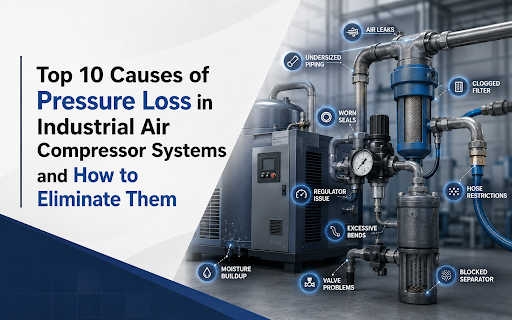
Pressure loss is one of the most common problems in compressed air systems, and often the most overlooked. Even a small drop forces compressors to work harder, pushing up energy bills and shortening equipment life. Knowing where pressure loss comes from is the first step towards fixing it.
What Causes Pressure Loss Across Your System
Pressure drop can creep in at almost any point between the compressor and the point of use. The most common culprits include undersized piping and fittings, leaking joints, valves and hoses, and clogged or worn filters. Long pipe runs with too many bends and restrictive couplings add further resistance, while a poorly maintained oil separator for compressor units can quietly reduce output over time. Incorrect valve sizing, condensate build-up in lines, dryer and aftercooler losses, and ageing or corroded pipework round out the list of usual suspects. Together, these issues chip away at system pressure, often unnoticed until output falls.
Pressure Drop, Air Demand and System Efficiency
Every bar of pressure lost means the compressor must work harder to deliver the same air demand at the point of use. This increases power consumption, generates excess heat, and adds strain on components. In variable demand environments, even minor pressure drops can force operators to raise the compressor’s set pressure, which increases energy costs further and reduces overall system efficiency.
How to Identify and Measure Pressure Loss
Regular pressure checks at multiple points, from the compressor outlet through to the farthest end use point, help pinpoint where losses occur. Installing pressure gauges before and after filters, dryers, and long pipe runs makes it easy to spot abnormal drops. A compressed air audit, measuring pressure under both static and running conditions, gives a clear picture of where the system is losing efficiency.
Practical Ways to Minimise Pressure Drop
Correct pipe sizing for the required flow rate is the foundation of a low-loss system. Keeping pipe runs short and direct, minimising bends, and using properly rated fittings all help. Routine leak detection using ultrasonic tools, along with timely filter and separator replacement, keeps resistance low. Choosing the right valves and couplings for the application also prevents unnecessary restriction.
Design and Maintenance Considerations
A well-designed distribution network accounts for future load growth, uses ring mains where suitable, and avoids unnecessary elbows and reducers. Scheduled maintenance, including filter changes, leak surveys, and inspection of separators and dryers, keeps pressure loss to a minimum over the system’s lifetime. Proactive design and upkeep together protect both efficiency and equipment longevity.
VEMPL has over 77 years of expertise in electromechanical engineering solutions, air compressors, and industrial pumps offered by leading water pump manufacturers. Reach out to us at +91 8976951701, +91 9819907445, 022 43117133, or email marketing@vemc.co.in.
Frequently Asked Questions (FAQs)
1. What is an acceptable pressure drop in a compressed air system?
A well-designed system should have a total pressure drop of under 10% of the compressor’s discharge pressure.
2. How often should air filters and separators be checked?
Filters and separators should be inspected regularly and replaced as per manufacturer recommendations to avoid restriction.
3. Can leaks alone cause significant pressure loss?
Yes, undetected leaks are one of the biggest contributors to pressure loss and wasted energy in industrial systems.
4. Does pipe material affect pressure drop?
Yes, smoother, corrosion-resistant piping reduces friction losses compared to older or corroded pipework.
5. Why does pressure loss increase energy costs?
Lost pressure forces the compressor to work harder or run at a higher set pressure, increasing power consumption.