
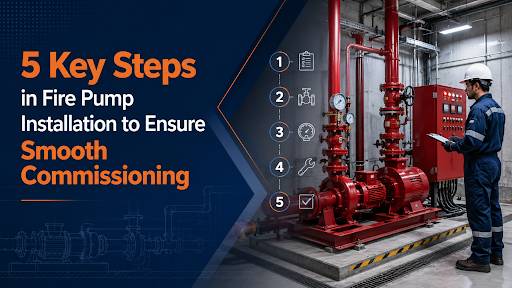
Getting a fire pump installation right from the outset makes commissioning far more straightforward. A well-planned installation, right from the foundation to the final performance check, sets the system up to perform reliably for years to come. Whether you are setting up a Kirloskar fire pump for a factory, warehouse, or commercial building, following a structured approach at every stage helps the whole process go smoothly.
Here are five key steps worth getting right, along with a few factors that experienced installers keep an eye on.
1. Site and Foundation Readiness
A good installation starts below ground level. The foundation should be levelled, cured and sized as per the manufacturer’s drawings, with proper drainage, ventilation and access for maintenance built in from the start. Taking the time to get this right gives the pump a stable, long-term base to operate from.
2. Pump, Motor/Engine Installation and Alignment
The pump and its driver, whether motor or diesel engine, should be mounted and aligned with care. Precise alignment, checked with a dial indicator or laser alignment tool, keeps the coupling running smoothly and supports quiet, efficient operation, particularly on larger systems.
3. Suction and Discharge Piping Considerations
Thoughtful piping design supports strong pump performance. Suction piping works best when kept short and straight, with minimal fittings for smooth flow. Discharge piping should be properly supported to keep the pump casing free of unnecessary stress. Working with an experienced Kirloskar fire pump dealer at this stage helps match the piping layout to the pump’s hydraulic requirements.
4. Electrical/Control and Auxiliary Connections
Control panels, wiring and auxiliary components such as pressure switches, gauges and jockey pumps all need to be connected and sequenced correctly. Careful attention to cable sizing, earthing and panel calibration here keeps the wider commissioning process on track.
5. Pre-commissioning Checks, Testing and Performance Verification
A full functional test, covering flow rate, pressure output, alarm response and automatic start sequences, confirms everything is working as intended. Recording these results against the pump’s rated performance curve gives a clear, documented picture that the system is ready for handover.
Common Installation Factors Worth Planning For
A few practical factors are worth keeping in mind while planning an installation: completing civil work early, confirming pipe sizing in advance, keeping documentation organised, testing control panels ahead of time, and coordinating closely between contractors. Building these into the project timeline from the start helps everything come together for a smooth, on-schedule commissioning.
A well-installed fire pump system is a valuable safeguard for any building, well beyond simply meeting compliance requirements. For businesses looking to source and install a dependable Kirloskar fire pump, working with an established Kirloskar fire pump dealer brings technical expertise to every stage, from foundation planning through to final commissioning.
Explore VEMPL’s fire pump installation solutions, contact us at +91 8976951701, +91 9819907445, 022 43117133, or email marketing@vemc.co.in.
Frequently Asked Questions
1. How long does a typical fire pump installation take?
This depends on system size and site readiness, but most installations, from foundation work to final commissioning, take a few weeks when planned well in advance.
2. Can an existing fire pump system be upgraded instead of replaced?
Yes, in many cases pumps, panels, or piping can be upgraded individually rather than replacing the whole system, provided the existing infrastructure is compatible.
3. How often should a fire pump be tested after commissioning?
Routine weekly and monthly checks, along with an annual performance test, are generally recommended to keep the system in reliable working condition.
4. Who should carry out fire pump installation and commissioning?
It is best handled by trained technicians or an authorised dealer familiar with the specific pump model and local fire safety regulations.