
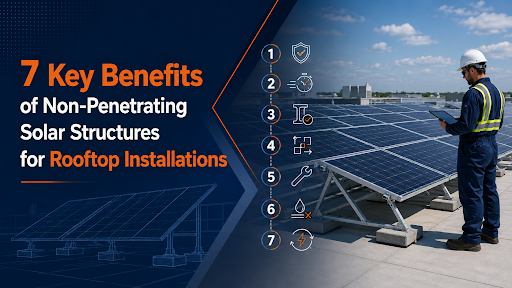
Rooftop solar is booming across Mumbai’s factories, warehouses, and commercial complexes, but the mounting structure chosen can make or break the roof’s long-term health. Non-penetrating, or ballasted, solar structures are fast becoming the preferred choice among solar EPC companies in Mumbai for exactly this reason. They offer a practical way to add generation capacity without compromising the building’s structural integrity. Here’s why this technology deserves your attention before your next project.
How Non-Penetrating Structures Work
Unlike conventional structures that are bolted or welded into the roof slab, non-penetrating structures rest on the surface using ballast weights, typically concrete blocks or trays, to stay in place. Friction and mass, not fasteners, hold the array steady, so the roof membrane remains completely undisturbed. The ballast is distributed carefully across the mounting frame, and module tilt angles are chosen to balance wind resistance with generation output.
1. No Roof Penetration, No Waterproofing Worries
Since nothing pierces the roof, there’s no risk of leaks around bolt holes, a common headache with conventional penetrating structures. This keeps existing waterproofing warranties intact and avoids the added expense of re-sealing work later.
2. Faster Installation and Deployment
With no drilling, curing time or civil work involved, ballasted structures can be assembled and positioned much quicker, shortening project timelines considerably. This also means less disruption to ongoing operations on site.
3. Better Roof Protection and Easier Maintenance
Because the structure sits above the roof surface, cleaning, waterproofing touch-ups or future re-roofing can be carried out without dismantling the entire array, saving both time and labour costs.
4. Engineered for Structural and Wind-Load Safety
Ballast quantity and layout are calculated based on local wind speeds, building height and roof exposure, ensuring the array stays put even during Mumbai’s monsoon gusts, without overloading the slab. Structural audits confirm the roof can bear the additional weight safely.
5. Works Across Different Rooftop Types
From flat RCC roofs to certain metal sheet roofs, non-penetrating designs adapt well, making them a versatile choice for varied industrial and commercial sites.
6. Cost-Effective Over the Structure’s Lifetime
Lower installation labour, no penetration-related repairs, and reduced long-term maintenance make ballasted systems more economical than penetrating alternatives over the plant’s life, even though upfront ballast material adds some weight.
7. Non-Invasive and Reversible
Since the structure isn’t fixed permanently, it can be relocated or removed without leaving structural damage, useful for leased premises or future roof upgrades.
Non-Penetrating vs Conventional Structures
Conventional penetrating structures use foundation bolts or welded feet, offering strong anchorage but at the cost of roof integrity and installation time. Non-penetrating systems trade a slightly heavier footprint for zero roof damage and quicker deployment, making them the preferred pick wherever preserving the existing roof matters most.
Factors to Evaluate Before Choosing
Before finalising a structure, assess the roof’s load-bearing capacity, local wind zone, roof slope, and drainage pattern. A qualified team offering solar EPC services should conduct a structural audit and wind-load study to recommend the right ballast design for your site.
VEMPL has over 77 years of expertise in electromechanical engineering solutions and industrial pumps offered by leading water pump manufacturers. Reach out to us at +91 8976951701, +91 9819907445, 022 43117133, or email marketing@vemc.co.in.
Frequently Asked Questions (FAQs)
1. What are non-penetrating solar structures?
Mounting systems held in place by ballast weight instead of roof penetrations or bolts.
2. Are ballasted structures safe for high-wind areas like Mumbai?
Yes, when ballast quantity is engineered against local wind-load calculations for the site.
3. Do non-penetrating structures suit all roof types?
They work best on flat RCC and select metal roofs; sloped or fragile roofs need evaluation.
4. Do these structures affect the roof warranty?
No, since there is no drilling involved, existing waterproofing warranties typically stay valid.
5. Are non-penetrating structures more expensive than conventional ones?
Installation costs are often lower, though ballast material adds some upfront weight and cost.