An air compressor is one of the most important utility assets in a manufacturing facility. From powering pneumatic tools and automation systems to supporting packaging, food processing, pharmaceuticals, and heavy engineering operations, compressed air plays a critical role in daily production.
However, selecting the right compressor is only part of the decision-making process. The expertise, service support, and reliability of your air compressor dealer can significantly impact system performance, maintenance costs, and equipment lifespan.
Many industrial buyers focus primarily on compressor specifications and pricing while overlooking the dealer’s capabilities. This often leads to installation issues, delayed service support, higher operating costs, and unexpected downtime.
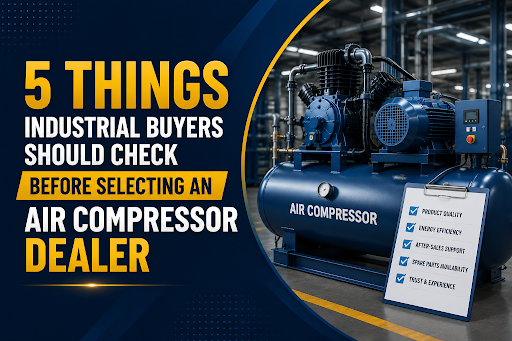
Before finalizing your purchase, here are five important factors every industrial buyer should evaluate when selecting an air compressor dealer.
1. Verify Whether the Air Compressor Dealer Is Authorized
The first and most important step is to confirm whether the air compressor dealer is authorized by the compressor manufacturer.
Authorized dealers receive direct support from the Original Equipment Manufacturer (OEM), including product training, technical updates, service guidelines, and access to genuine spare parts.
Working with an authorized dealer offers several advantages:
- Genuine compressor products
- Manufacturer-backed warranties
- Access to original spare parts
- OEM-trained service engineers
- Better technical support
Whether you are purchasing a screw compressor, reciprocating compressor, or oil-free compressor, an authorized air compressor dealer helps ensure product authenticity and long-term reliability.
2. Assess Service Support and Response Time
A compressor breakdown can disrupt production schedules and result in significant financial losses.
For this reason, service capabilities should be a major consideration when evaluating an air compressor dealer.
Important questions to ask include:
- Do they have dedicated service engineers?
- How quickly can they respond to emergencies?
- Do they offer on-site troubleshooting?
- Are preventive maintenance services available?
- Can they support multiple plant locations?
The best air compressor dealer is not necessarily the one offering the lowest price but the one capable of minimizing downtime when problems occur.
Fast service response can often save more money than any initial purchase discount.
3. Evaluate Product Range and Technical Expertise
Every industrial application has different compressed air requirements.
A pharmaceutical plant may require oil-free compressed air, while an automotive facility may require high-capacity rotary screw compressors with Variable Frequency Drives (VFDs).
A reliable air compressor dealer should be able to recommend solutions based on:
- Air demand
- Pressure requirements
- Duty cycle
- Future expansion plans
- Energy consumption goals
Look for dealers that offer:
- Rotary screw compressors
- Reciprocating compressors
- Oil-free compressors
- VSD compressors
- Air dryers
- Filters
- Air receivers
- Compressed air accessories
A broad product portfolio demonstrates strong technical capability and allows the dealer to recommend the most suitable solution rather than simply selling a single product.
4. Check Their Approach to Energy Efficiency
Energy costs account for the largest share of compressor lifecycle expenses.
In many manufacturing facilities, compressed air systems consume a significant percentage of total electricity usage. An experienced air compressor dealer should focus not only on equipment supply but also on reducing energy consumption.
Look for dealers that offer:
- Compressed air audits
- Leak detection surveys
- Energy-efficiency assessments
- VSD compressor recommendations
- System optimization services
A knowledgeable air compressor dealer can help identify opportunities to reduce energy wastage and improve overall system performance.
In many cases, optimizing the compressed air system can deliver greater savings than replacing the compressor itself.
5. Review Spare Parts Availability and Maintenance Support
Even the most reliable compressors require periodic maintenance and replacement of consumable components.
Before selecting an air compressor dealer, evaluate their spare parts support network.
Key areas to verify include:
- Availability of genuine spare parts
- Stock levels of critical components
- Lead times for replacement parts
- Preventive maintenance programs
- Annual Maintenance Contract (AMC) options
Common compressor spare parts include:
- Air filters
- Oil filters
- Oil separators
- Belts
- Lubricants
- Service kits
A dependable air compressor dealer should maintain adequate inventory to support customers without lengthy delays.
Consistent spare parts availability contributes directly to improved equipment uptime and lower maintenance costs.
Additional Questions Industrial Buyers Should Ask
Before making a final decision, consider asking the following questions:
How many years have you been in the compressor business?
Industry experience often reflects technical knowledge and service maturity.
Can you provide references from similar industries?
Customer references help validate the dealer’s expertise and support capabilities.
Do you offer installation and commissioning services?
Proper installation plays a major role in compressor performance and longevity.
What warranty support is available?
Understanding warranty coverage helps avoid unexpected expenses later.
Do you provide AMC services?
Preventive maintenance programs can significantly improve compressor reliability and efficiency.
Common Mistakes Buyers Should Avoid
When selecting an air compressor dealer, avoid these common mistakes:
- Choosing solely based on price
- Ignoring after-sales service quality
- Overlooking spare parts availability
- Not verifying dealer authorization
- Selecting an oversized or undersized compressor
- Failing to evaluate lifecycle costs
A lower initial purchase price may appear attractive but can result in significantly higher operating expenses over time.
Conclusion
Choosing the right air compressor dealer is a strategic decision that affects equipment reliability, energy efficiency, maintenance costs, and overall plant productivity.
Before making a purchase, industrial buyers should verify dealer authorization, assess service capabilities, evaluate technical expertise, review energy-efficiency support, and confirm spare parts availability. These five factors can help ensure that your compressed air system delivers reliable performance throughout its lifecycle.
In today’s competitive industrial environment, the best air compressor dealer is not simply a supplier but a long-term partner that supports your operational goals through quality products, technical expertise, and dependable service. If you’re looking for a trusted air compressor dealer, VEMPL is an excellent choice, offering genuine products, expert consultation, reliable after-sales support, and end-to-end compressed air solutions tailored to your industrial requirements.