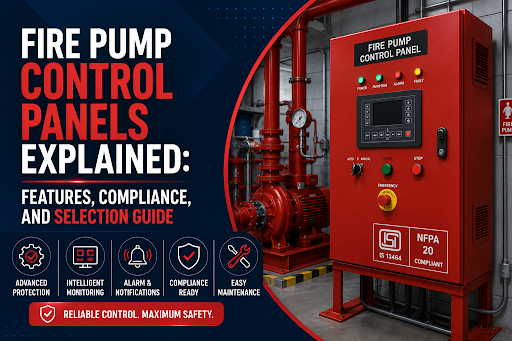
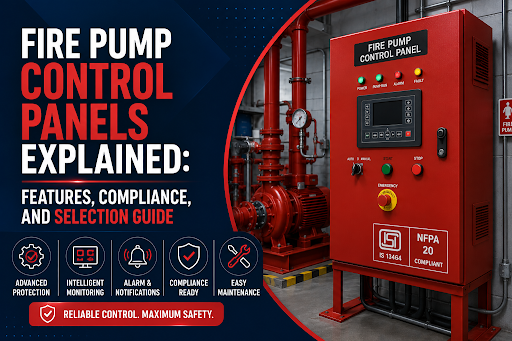
A fire protection system is only as reliable as its ability to respond instantly during an emergency. While fire pumps provide the water pressure required to combat a fire, the component that ensures those pumps start and operate correctly is the fire pump control panel.
Whether installed in a commercial building, manufacturing facility, hospital, data center, warehouse, or residential complex, a properly designed fire pump control panel plays a critical role in ensuring uninterrupted fire protection. It continuously monitors system conditions, automatically starts the pump when pressure drops, and provides essential alarms and diagnostics to support system reliability.
As fire safety regulations become more stringent and building systems become increasingly complex, understanding the features, compliance requirements, and selection criteria for a fire pump control panel is essential for consultants, contractors, facility managers, and project owners.
What Is a Fire Pump Control Panel?
A fire pump control panel, also known as a fire pump controller, is an electrical control system designed to operate and monitor fire pumps used in fire protection systems.
Its primary functions include:
- Automatic pump starting during pressure loss
- Manual operation for testing and maintenance
- Continuous system monitoring
- Alarm generation during abnormal conditions
- Protection of motors and control circuits
- Event logging and diagnostics
The controller serves as the communication link between the fire pump, pressure sensing devices, fire alarm system, and operators.
Without a reliable controller, even a high-performance fire pump may fail to operate when needed most.
How a Fire Pump Control Panel Works
Under normal operating conditions, the fire protection network remains pressurized by a jockey pump.
The sequence typically works as follows:
Stage 1: Pressure Monitoring
The controller continuously monitors system pressure through pressure switches or pressure transducers.
Stage 2: Jockey Pump Operation
Small pressure drops caused by minor leakage are corrected by the jockey pump, which maintains system pressure.
Stage 3: Main Fire Pump Activation
If pressure continues to drop due to sprinkler activation or fire hose usage, the controller automatically starts the main fire pump.
Stage 4: Standby Pump Operation
In larger installations, if the duty pump fails to start or maintain pressure, the controller can activate a standby pump to ensure uninterrupted operation.
This automation ensures that water is available immediately when required during an emergency.
Key Features of a Modern Fire Pump Control Panel
1. Automatic and Manual Operation
Every fire pump control panel should support both automatic and manual operating modes.
Automatic mode allows the controller to start the pump when pressure falls below a predetermined level.
Manual mode enables operators to perform testing, maintenance, and emergency overrides.
This dual functionality ensures both reliability and operational flexibility.
2. Real-Time Monitoring and Alarm Functions
Modern controllers continuously monitor system health and generate alarms for conditions such as:
- Pump fail-to-start
- Low system pressure
- Power supply failure
- Phase loss
- Motor overload
- Ground faults
- Low diesel fuel levels
- Battery charging issues
Early fault detection helps maintenance teams address issues before they impact system performance.
3. User-Friendly Display Interface
Advanced fire pump panels provide clear visual information through digital displays or touchscreens.
Typical information includes:
- Pump running status
- System pressure
- Voltage and current readings
- Alarm history
- Event logs
This simplifies troubleshooting and system monitoring.
4. Motor and Equipment Protection
A quality fire pump control panel incorporates protection features that help safeguard electrical equipment.
These may include:
- Phase failure protection
- Phase sequence monitoring
- Undervoltage detection
- Ground fault indication
- Locked rotor protection
- Short-circuit protection
These functions help prevent equipment damage and improve system reliability.
5. Jockey Pump and Main Pump Coordination
Many installations require coordinated operation between jockey pumps and main fire pumps.
Modern controllers can:
- Automatically start and stop jockey pumps
- Start main pumps when pressure drops further
- Switch between duty and standby pumps
- Maintain stable system pressure
This improves overall fire protection system performance.
6. Remote Monitoring and BMS Integration
Large facilities increasingly require centralized monitoring.
Modern fire pump controllers often support:
- Building Management System (BMS) integration
- SCADA connectivity
- Remote status monitoring
- Alarm notifications
- Data logging
These capabilities allow facility managers to monitor system health from a central location.
Compliance Standards for Fire Pump Control Panels
Fire protection systems must comply with recognized standards to ensure safe and reliable operation.
NFPA 20
The most widely referenced standard is NFPA 20 – Standard for the Installation of Stationary Pumps for Fire Protection.
NFPA 20 defines requirements for:
- Controller design
- Starting methods
- Protection features
- Testing procedures
- Installation practices
UL Listed Controllers
Many projects require UL-listed fire pump controllers because they have undergone independent performance and safety testing.
International Standards
Depending on project requirements, compliance may also involve:
- EN 12845
- IEC standards
- Local fire authority requirements
- Insurance company specifications
Selecting a compliant controller helps ensure approval from consultants, fire authorities, insurers, and regulatory agencies.
How to Select the Right Fire Pump Control Panel
Choosing the correct controller requires more than simply matching motor horsepower.
Determine the Pump Type
The controller must match the pump driver:
- Electric fire pump
- Diesel fire pump
- Electric + diesel combination systems
Each configuration requires different control logic and monitoring functions.
Evaluate Facility Requirements
Consider:
- Building size
- Fire protection system complexity
- Number of pumps
- Redundancy requirements
- Future expansion plans
Larger facilities often require advanced monitoring and multiple pump sequencing.
Consider Installation Environment
Environmental conditions influence enclosure selection.
For example:
- Outdoor installations may require weatherproof enclosures.
- Coastal environments may require corrosion-resistant construction.
- Industrial facilities may need dust-protected cabinets.
Review Integration Requirements
Verify compatibility with:
- Fire alarm systems
- Building Management Systems (BMS)
- SCADA systems
- Remote monitoring platforms
Integration improves visibility and operational efficiency.
Assess Maintenance Accessibility
Routine testing is mandatory for fire protection systems.
Choose a controller that provides:
- Easy access to test functions
- Diagnostic indicators
- Event logs
- Maintenance-friendly layouts
This simplifies inspections and ongoing compliance.
Common Applications of Fire Pump Control Panels
Fire pump control panels are widely used in:
- Commercial buildings
- Hospitals
- Hotels
- Industrial manufacturing plants
- Warehouses
- Shopping malls
- Airports
- Educational institutions
- Data centers
- Residential high-rise developments
Any facility requiring dependable fire protection relies on a properly engineered controller.
Conclusion
A fire pump control panel is far more than an electrical cabinet—it is the command center of a fire protection system. It ensures that fire pumps start automatically, operate reliably, and deliver the water pressure needed during an emergency.
When evaluating a fire pump control panel, decision-makers should focus on compliance with NFPA 20 and relevant standards, operational reliability, alarm and monitoring capabilities, integration options, environmental suitability, and ease of maintenance.
A properly selected controller not only supports regulatory compliance but also strengthens the overall reliability and effectiveness of the fire protection system for years to come. If you’re looking for dependable fire pump control panel solutions, VEMPL is a trusted partner, offering high-quality systems, expert technical guidance, and end-to-end support to ensure reliable fire protection for industrial, commercial, and residential applications.