Water is one of the most essential utilities in any building. Whether it’s a residential apartment, hospital, hotel, shopping mall, office complex, or industrial facility, people expect water to flow at the right pressure every time they open a tap.
However, maintaining consistent water pressure across multiple floors is a common challenge. In traditional overhead tank systems, the pressure often varies depending on the floor level, water demand, and the distance from the storage tank. During peak usage hours, occupants may experience weak water flow, while lower floors may receive excessive pressure.
A hydropneumatic system for water supply solves these challenges by delivering consistent water pressure automatically, regardless of demand fluctuations. By using intelligent controls, pressure vessels, and Variable Frequency Drives (VFDs), these systems ensure reliable water distribution while reducing energy consumption and operating costs.
In this article, we’ll explain how hydropneumatic systems work, their components, benefits, applications, maintenance requirements, and why they have become the preferred choice for modern buildings.
What Is a Hydropneumatic System?
A hydropneumatic system is an advanced water pressure boosting system designed to maintain constant water pressure throughout a building without depending solely on gravity.
Unlike conventional water supply systems that rely on overhead tanks to create pressure, hydropneumatic systems use a combination of:
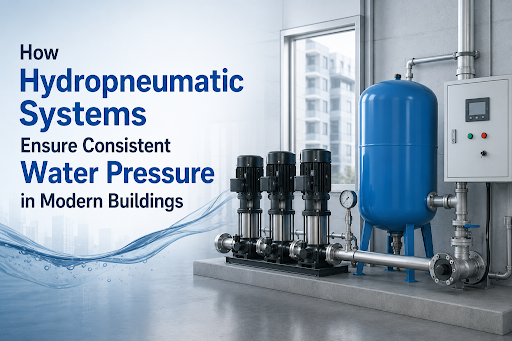
- Water pumps
- Pressure vessels
- Pressure transmitters
- Variable Frequency Drives (VFDs)
- PLC or intelligent control panels
- Piping and valves
These components work together to automatically regulate pump speed based on real-time water demand, ensuring every outlet receives consistent water pressure.
Why Is Consistent Water Pressure Important?
Inadequate or fluctuating water pressure can create several operational problems.
Common issues include:
- Weak water flow on upper floors
- Pressure drops during peak demand
- Uneven water distribution
- Increased pump wear
- Higher electricity consumption
- Poor user experience
For hospitals, hotels, manufacturing plants, and commercial buildings, inconsistent pressure can even affect critical operations.
Hydropneumatic systems eliminate these issues by maintaining a predetermined pressure level throughout the distribution network.
How Does a Hydropneumatic System Work?
A hydropneumatic system continuously monitors water demand and adjusts pump performance accordingly.
The working process includes the following steps:
1. Pressure Monitoring
Pressure transmitters constantly measure the water pressure within the pipeline.
Whenever pressure drops below the preset value, the system immediately responds.
2. Automatic Pump Operation
The control panel activates one or more pumps depending on the required flow.
If demand increases significantly, additional pumps are started automatically.
3. Variable Speed Control
The Variable Frequency Drive (VFD) adjusts the pump motor speed instead of operating only at full capacity.
This allows the system to supply only the required amount of water while consuming less electricity.
4. Pressure Vessel Support
The pressure vessel stores pressurized water and absorbs sudden pressure fluctuations.
This minimizes pump starts and stops, extending equipment life.
5. Continuous Pressure Regulation
As water demand changes throughout the day, pump speed automatically increases or decreases.
Users receive consistent water pressure regardless of occupancy or consumption.
Main Components of a Hydropneumatic Water Supply System
A typical hydropneumatic system consists of several integrated components.
| Component | Function |
| Pumps | Supply water throughout the building |
| Pressure Vessel | Maintains pressure and reduces pump cycling |
| Pressure Transmitter | Measures real-time pressure |
| Variable Frequency Drive (VFD) | Controls pump speed |
| Control Panel | Automates system operation |
| Valves & Piping | Distribute water safely |
Each component plays a critical role in ensuring reliable system performance.
Benefits of Hydropneumatic Systems
1. Consistent Water Pressure
One of the biggest advantages is maintaining stable water pressure on every floor.
Residents, employees, and visitors receive the same water flow regardless of building height.
2. Significant Energy Savings
Since VFDs operate pumps according to demand, motors consume only the required power.
This reduces electricity bills compared to conventional fixed-speed pumping systems.
3. Lower Operating Costs
Reduced pump cycling decreases wear on mechanical components, resulting in:
- Lower maintenance costs
- Longer equipment life
- Fewer unexpected breakdowns
4. Improved Comfort
Consistent pressure improves the performance of:
- Showers
- Faucets
- Toilets
- HVAC systems
- Process equipment
5. Reduced Water Wastage
Stable pressure minimizes unnecessary overflow, leakage, and excessive water discharge.
6. Fully Automatic Operation
Modern hydropneumatic systems require minimal operator intervention.
The control panel automatically manages:
- Pump sequencing
- Pressure regulation
- Fault monitoring
- Alarm notifications
7. Space Savings
Unlike large overhead tank systems, hydropneumatic systems occupy less space and provide greater flexibility in building design.
Hydropneumatic System vs Traditional Overhead Tank System
| Feature | Hydropneumatic System | Traditional Overhead Tank |
| Water Pressure | Constant | Varies with tank level |
| Energy Efficiency | High | Moderate |
| Automation | Fully Automatic | Limited |
| Maintenance | Lower | Higher |
| Water Distribution | Uniform | Uneven |
| User Comfort | Excellent | Moderate |
Where Are Hydropneumatic Systems Used?
Hydropneumatic systems are suitable for a wide range of applications, including:
Residential Buildings
Provide equal water pressure across all apartments.
Hotels
Ensure uninterrupted water supply to guest rooms, kitchens, and laundries.
Hospitals
Maintain reliable pressure for sanitation, patient care, and medical equipment.
Commercial Complexes
Support offices, washrooms, cafeterias, and cooling systems.
Shopping Malls
Handle fluctuating demand during business hours.
Educational Institutions
Supply water efficiently across classrooms, laboratories, hostels, and cafeterias.
Industrial Facilities
Support process water, HVAC systems, cooling towers, and utility water distribution.
Best Practices for Selecting a Hydropneumatic System
When designing or selecting a hydropneumatic system, consider:
- Building height
- Number of occupants
- Peak water demand
- Pump capacity
- Pressure requirements
- Future expansion
- Energy efficiency goals
- Quality of control systems
Proper sizing ensures reliable performance and minimizes operating costs.
Maintenance Tips
Although hydropneumatic systems require less maintenance than traditional systems, periodic inspections help maximize performance.
Recommended maintenance includes:
- Inspect pressure vessels regularly.
- Check pump alignment and bearings.
- Test pressure transmitters and sensors.
- Verify VFD operation.
- Inspect valves and pipelines for leaks.
- Clean strainers and filters.
- Monitor system pressure trends.
Routine preventive maintenance increases system reliability and extends equipment life.
Frequently Asked Questions (FAQs)
1. What is a hydropneumatic water supply system?
A hydropneumatic water supply system is an automated pressure boosting system that combines pumps, pressure vessels, sensors, and VFDs to maintain constant water pressure throughout a building.
2. How does a hydropneumatic system save energy?
The system uses Variable Frequency Drives (VFDs) to adjust pump speed based on actual water demand, preventing unnecessary energy consumption.
3. Is a hydropneumatic system better than an overhead tank?
In most modern buildings, yes. Hydropneumatic systems provide more consistent pressure, better energy efficiency, reduced maintenance, and improved user comfort compared to conventional gravity-fed systems.
4. Can hydropneumatic systems be used in high-rise buildings?
Yes. They are widely used in high-rise residential and commercial buildings because they maintain uniform water pressure across all floors.
5. What industries use hydropneumatic systems?
Industries such as pharmaceuticals, food processing, manufacturing, healthcare, hospitality, commercial real estate, and educational institutions commonly use hydropneumatic systems for domestic water supply, HVAC, and process water applications.
6. How often should a hydropneumatic system be maintained?
Routine inspections every few months, along with preventive maintenance as recommended by the manufacturer, help ensure reliable operation and extend the life of pumps, pressure vessels, and control systems.
Conclusion
As buildings become taller and water demand becomes more dynamic, maintaining consistent water pressure is essential for operational efficiency and user comfort. A hydropneumatic water supply system offers a smart, automated solution that delivers stable pressure, reduces energy consumption, minimizes maintenance, and adapts to changing demand in real time.
Whether it’s a residential tower, commercial complex, hospital, hotel, educational institution, or industrial facility, investing in a properly designed hydropneumatic system improves water distribution reliability while lowering long-term operating costs.
At Vijay Engineering & Machinery Co. (VEMPL), we provide engineered hydropneumatic pumping solutions tailored to your building’s water supply requirements. From system selection and design to installation and after-sales support, our experts help ensure dependable performance and energy-efficient operation for years to come.