Introduction
Industrial pumping systems are often expected to operate reliably for years, sometimes decades. However, a pump system that was correctly selected and efficient when installed may no longer deliver the same performance as operating conditions, production requirements, equipment condition and energy costs change.
This is where industrial pump retrofitting becomes an important engineering solution.
Retrofitting an existing pump system can improve hydraulic performance, reduce energy consumption, restore reliability and extend equipment life without necessarily replacing the entire installation. For industrial facilities, commercial buildings, infrastructure projects and process applications, a well-planned retrofit can often deliver a better balance between capital expenditure, operational performance and long-term reliability.
For companies looking for technically capable industrial water pump suppliers in Mumbai, the ability to evaluate an existing installation and recommend the right retrofit is just as important as supplying a new pump.
But how do you know when a pump should be retrofitted, overhauled or completely replaced?
The answer depends on several factors including pump efficiency, actual operating conditions, wear, hydraulic requirements, motor performance, maintenance history, energy consumption and the remaining life of the equipment.
This guide explains when industrial pump retrofitting makes sense, which warning signs to look for, what components can be upgraded and how businesses can determine whether retrofitting or replacement is the more economical solution.
What Is Industrial Pump Retrofitting?
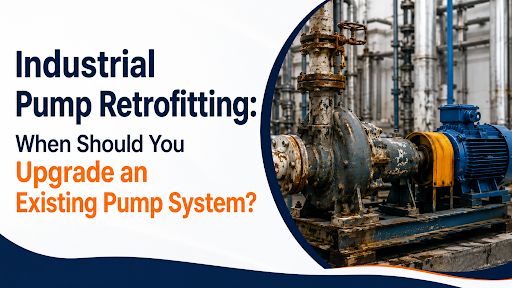
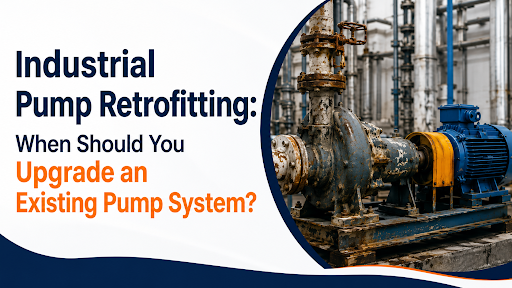
Industrial pump retrofitting is the process of upgrading, modifying, restoring or replacing selected components of an existing pumping system to improve its performance, reliability, efficiency or suitability for current operating conditions.
A retrofit does not always mean replacing the complete pump.
Depending on the application, the retrofit may involve:
- Replacing worn pump components
- Replacing or modifying the impeller
- Impeller trimming or replacement
- Shaft and sleeve replacement
- Bearing replacement
- Mechanical seal replacement
- Wear ring replacement
- Pump casing inspection and restoration
- Baseplate and coupling corrections
- Shaft alignment
- Motor replacement or upgrade
- Variable Frequency Drive (VFD) integration
- Hydraulic modification
- Control system upgrades
- Performance testing
- Re-rating the pump for changed operating conditions
- Energy-efficiency improvements
The objective is to bring the pumping system closer to the required Best Efficiency Point (BEP) and ensure that the pump operates reliably within its suitable operating range.
A competent team of industrial water pump suppliers in Mumbai should therefore evaluate the complete pump system rather than simply recommending a replacement pump based on the nameplate rating.
Why Consider Retrofitting an Existing Industrial Pump?
A pump may continue to run even when it is no longer operating efficiently.
This is one of the biggest challenges in industrial pumping systems.
A pump can consume electricity, deliver water and appear operational while simultaneously suffering from:
- Reduced hydraulic efficiency
- Excessive vibration
- Increased power consumption
- Leakage
- Frequent breakdowns
- Reduced flow
- Insufficient pressure
- Cavitation
- Bearing failures
- Seal failures
- Operating far away from the BEP
- Oversizing or undersizing
- Changing system resistance
In such cases, simply continuing maintenance may not solve the underlying problem.
A retrofit can address the root cause while allowing the facility to retain useful parts of the existing installation.
10 Signs That Your Industrial Pump May Need Retrofitting
1. Pump Efficiency Has Declined
One of the clearest indications that a pump requires attention is a gradual decline in efficiency.
If the pump consumes substantially more power to deliver the same flow and head, internal wear or hydraulic mismatch may be responsible.
Pump efficiency can decline due to:
- Impeller wear
- Increased clearances
- Damaged wear rings
- Internal corrosion
- Mechanical damage
- Incorrect impeller diameter
- Operating away from BEP
- Changes in system conditions
A pump performance test or energy audit can help establish whether the pump is still operating economically.
This is one area where experienced industrial water pump suppliers in Mumbai can add significant value by assessing actual field conditions instead of relying only on historical pump data.
2. Energy Consumption Is Increasing
Energy can represent a significant portion of the lifecycle cost of an industrial pumping system.
If a pump’s electricity consumption has increased without a corresponding increase in output, it may be time to investigate the system.
Potential causes include:
- Hydraulic deterioration
- Oversized pump
- Throttling losses
- Poor alignment
- Motor inefficiency
- Excessive mechanical friction
- Operating away from the design point
- Changes in pipeline conditions
A pump retrofit can sometimes reduce energy consumption without replacing the entire pumping installation.
Why Energy Assessment Matters
The correct evaluation should compare:
Input Power → Flow → Head → Hydraulic Efficiency → Operating Hours → Annual Energy Consumption
This provides a more meaningful picture than looking at motor rating alone.
3. Flow or Pressure Is No Longer Adequate
Industrial processes can change over time.
A facility may add production lines, extend pipelines, increase water demand or modify its distribution network. A pump originally selected for the system may then become unsuitable.
Typical symptoms include:
- Insufficient pressure at the farthest point
- Reduced flow
- Longer filling times
- Poor cooling-water circulation
- Inadequate process-water supply
- Difficulty maintaining required pressure
In such cases, the existing pump may still be mechanically sound but hydraulically unsuitable.
A retrofit may involve changing the impeller, modifying the pump arrangement or replacing selected components to match the revised duty requirement.
4. The Pump Is Operating Away From Its Best Efficiency Point
Every centrifugal pump has a performance curve.
The Best Efficiency Point (BEP) represents the operating region where the pump achieves its highest hydraulic efficiency under the specified conditions.
Operating significantly away from the BEP can result in:
- Increased vibration
- Higher radial loads
- Increased bearing stress
- Seal problems
- Hydraulic instability
- Higher energy consumption
- Reduced pump life
Therefore, a pump should not be evaluated only on whether it can produce the required flow and head.
The operating point matters.
A professional assessment should compare the actual duty point against the manufacturer’s pump performance curve.
5. Frequent Mechanical Seal Failures
Repeated mechanical seal failures are often treated as a maintenance problem.
However, frequent seal failure can indicate a deeper issue.
Possible causes include:
- Shaft misalignment
- Excessive vibration
- Shaft runout
- Incorrect seal selection
- Dry running
- Cavitation
- Bearing wear
- Operating outside the recommended range
Replacing the mechanical seal repeatedly without addressing the underlying cause can increase maintenance costs.
During a retrofit, the complete rotating assembly, alignment, bearing condition and hydraulic operating point should be evaluated.
6. Excessive Vibration or Noise
Vibration is an important indicator of pump health.
Increasing vibration may be associated with:
- Misalignment
- Bearing deterioration
- Unbalanced rotating components
- Cavitation
- Bent shaft
- Foundation problems
- Coupling issues
- Hydraulic instability
- Operation away from the recommended operating range
A retrofit should therefore not focus only on the pump internals.
The complete pump-motor-baseplate-coupling system should be assessed.
7. Spare Parts Are Becoming Difficult to Source
Older pump models can become increasingly difficult to maintain when original components are discontinued or difficult to procure.
This can create:
- Longer maintenance downtime
- Higher spare-part costs
- Dependence on obsolete components
- Increased inventory requirements
- Difficulty maintaining critical equipment
Where the pump casing and basic configuration remain suitable, retrofitting selected components can sometimes extend the useful life of the equipment.
For critical industrial installations, this can be more practical than waiting for a complete pump replacement.
8. Operating Conditions Have Changed
A pump selected 10 or 15 years ago may no longer be operating under the same conditions.
Changes may include:
- Increased flow requirement
- Increased head requirement
- Reduced water availability
- Changes in fluid characteristics
- New production processes
- Pipeline modifications
- Additional equipment
- Changes in operating hours
This is a critical reason to reassess existing pumps.
The question should not simply be:
“Is the pump old?”
The more important question is:
“Is the pump still correctly matched to today’s system requirements?”
9. Pump Downtime Is Increasing
Repeated breakdowns are a strong indication that the existing maintenance strategy may no longer be sufficient.
Consider a pump that experiences:
- Repeated bearing failures
- Frequent seal replacement
- Shaft problems
- Coupling failures
- Impeller damage
- Unexpected vibration
- Frequent emergency shutdowns
At some point, the cumulative maintenance cost and production risk can become greater than the cost of a properly engineered retrofit.
10. The Pump Is Oversized
Oversizing is a common issue in pumping systems.
An oversized pump may be capable of delivering more flow and head than the system actually requires.
Operators may then control the excess flow through throttling valves.
This can result in unnecessary energy consumption.
A retrofit may involve:
- Impeller modification
- Hydraulic re-rating
- VFD installation
- Pump replacement
- System optimisation
The right solution depends on the operating profile and hydraulic requirements.
Pump Retrofitting vs Pump Replacement
Not every old pump should be replaced.
Similarly, not every pump should be retrofitted.
The decision should be based on engineering and lifecycle economics.
| Parameter | Retrofitting | Complete Replacement |
| Existing casing condition | Good | Poor/damaged |
| Hydraulic requirements | Can be achieved through modification | Major change required |
| Initial investment | Generally lower | Generally higher |
| Installation disruption | Usually lower | Potentially higher |
| Spare availability | Can improve | New spares available |
| Equipment age | Moderate/old but structurally sound | Very old or obsolete |
| Energy improvement | Possible | Potentially higher |
| Existing piping | Can often be retained | May require modification |
| Foundation | Can often be retained | May require modification |
| Downtime | Usually lower | Potentially higher |
| Long-term suitability | Depends on condition | Generally strong when correctly selected |
The best approach is to evaluate the total lifecycle cost, not simply the purchase price.
When Should You Retrofit Instead of Replace?
Retrofitting is generally worth investigating when:
- The pump casing is structurally sound.
- The pump can still meet the required duty after modification.
- The existing foundation and piping are suitable.
- Major components can be restored or replaced.
- The hydraulic requirement has not changed drastically.
- Energy savings can justify the retrofit.
- Replacement would involve extensive piping modifications.
- Downtime needs to be minimised.
- The existing equipment has a suitable configuration.
- The retrofit provides an acceptable remaining service life.
An experienced team of industrial water pump suppliers in Mumbai can assess these parameters and determine whether refurbishment, retrofit or replacement is the most suitable approach.
When Is Complete Pump Replacement Better?
A new pump may be more appropriate when:
- The casing is severely damaged.
- The pump is obsolete.
- Required performance cannot be achieved through retrofit.
- The operating conditions have changed substantially.
- The existing pump is fundamentally oversized or undersized.
- Spare parts are unavailable.
- Energy efficiency improvements require a fundamentally different hydraulic design.
- Maintenance costs have become excessive.
- The remaining useful life is very limited.
- Safety or reliability requirements cannot be met through refurbishment.
The decision should be based on technical feasibility and lifecycle economics rather than equipment age alone.
What Components Can Be Upgraded During a Pump Retrofit?
A pump retrofit can involve several components depending on the condition assessment.
Impeller
The impeller is one of the most important hydraulic components.
Depending on the pump design and required duty, the impeller may be:
- Trimmed
- Rebalanced
- Replaced
- Upgraded
Correct impeller selection can help bring the pump closer to the required operating point.
Bearings
Worn bearings can contribute to:
- Vibration
- Noise
- Shaft movement
- Increased mechanical losses
- Premature component failure
Bearing replacement should be accompanied by appropriate inspection and alignment.
Mechanical Seal
Mechanical seals should be selected based on:
- Fluid
- Temperature
- Pressure
- Shaft speed
- Material compatibility
- Operating conditions
Shaft
Shaft condition should be checked for:
- Wear
- Corrosion
- Runout
- Surface damage
- Dimensional tolerance
A damaged shaft may require replacement rather than simple refurbishment.
Wear Rings
Excessive clearance between rotating and stationary components can reduce pump efficiency.
Replacing worn wear rings can restore appropriate internal clearances and improve hydraulic performance.
Coupling and Alignment
Correct coupling alignment is essential for reliable operation.
Poor alignment can cause:
- Bearing failure
- Seal failure
- Vibration
- Coupling damage
- Shaft problems
Alignment should therefore form an integral part of the retrofit process.
The Importance of Pump Performance Testing
A retrofit should not end with component replacement.
The modified pump should be evaluated to determine whether it delivers the intended performance.
A performance test can assess parameters such as:
- Flow rate
- Head
- Motor input power
- Efficiency
- Speed
- Operating condition
- Pressure
- Vibration, where applicable
Performance testing provides objective evidence that the pump is operating as intended.
For critical installations, this can be particularly valuable for establishing baseline performance and future maintenance requirements.
Pump Energy Audits: Finding Hidden Savings
A pump can be mechanically healthy and still consume excessive energy.
This is why an energy audit can be an important part of pump retrofit planning.
A pump energy assessment can examine:
- Actual flow
- Actual head
- Input power
- Operating hours
- Pump efficiency
- Motor efficiency
- Throttling losses
- System resistance
- Operating point
- Potential control improvements
Example
Suppose an industrial pump operates for several thousand hours every year.
Even a modest reduction in input power can create significant annual energy savings.
Therefore, the financial evaluation should consider:
Annual Energy Savings = Reduction in kW × Annual Operating Hours × Electricity Cost
The resulting savings can then be compared with the retrofit investment to estimate the potential payback period.
How to Evaluate an Existing Industrial Pump Before Retrofitting
A systematic assessment should typically follow these steps.
Step 1: Establish the Actual Duty Point
Record:
- Flow
- Head
- Pressure
- Speed
- Power consumption
- Operating hours
Do not rely only on the original design data.
Step 2: Review Pump Performance
Compare the actual operating point against the pump’s performance curve.
Determine whether the pump is operating near an appropriate efficiency region.
Step 3: Inspect Mechanical Components
Check:
- Bearings
- Shaft
- Impeller
- Wear rings
- Mechanical seal
- Coupling
- Baseplate
- Foundation
Step 4: Evaluate Motor Performance
The motor should be checked for:
- Rated power
- Loading
- Efficiency
- Current
- Voltage
- Operating condition
A high-efficiency pump paired with an inefficient motor may still result in poor overall system performance.
Step 5: Assess the Piping System
Check for:
- Excessive pressure drop
- Valve throttling
- Pipeline restrictions
- Changes in piping
- Blockages
- Incorrect pipe sizing
Step 6: Identify the Root Cause
Do not simply replace the component that failed.
Determine why it failed.
Step 7: Develop Retrofit Options
Depending on the findings, possible solutions may include:
- Component replacement
- Impeller modification
- Pump re-rating
- Motor upgrade
- VFD integration
- Alignment correction
- Hydraulic optimisation
- Complete pump replacement
Step 8: Compare Lifecycle Economics
Compare:
Repair Cost + Energy Cost + Maintenance Cost + Downtime Risk
Against:
Retrofit Investment + Expected Savings + Remaining Service Life
This provides a much stronger basis for decision-making.
Can a VFD Be Part of a Pump Retrofit?
Yes.
A Variable Frequency Drive can be considered where the application requires variable flow or pressure.
A VFD changes motor speed according to system demand.
Potential benefits include:
- Reduced throttling losses
- Better flow control
- Improved pressure control
- Reduced energy consumption
- Smoother operation
- Potential reduction in mechanical stress
However, VFD installation should not be treated as a universal solution.
The pump’s hydraulic characteristics, motor compatibility, minimum flow requirements and system control philosophy should be evaluated before implementation.
Common Industrial Applications for Pump Retrofitting
Pump retrofit projects can be relevant across many applications, including:
Industrial Water Supply
Pumps used for raw water transfer, process water and utility-water systems may require retrofit as demand changes.
Cooling Water Systems
Cooling-water pumps operate for long periods and therefore offer significant opportunities for energy optimisation.
HVAC Systems
Chilled-water and condenser-water pumping systems can benefit from hydraulic optimisation and variable-speed control.
Process Industries
Chemical, pharmaceutical, food processing and manufacturing facilities may need pump upgrades when process requirements change.
Fire Protection Systems
Critical fire-water pumping systems require particular attention to reliability, compliance and performance. Any modification must be evaluated against applicable design requirements and system obligations.
Infrastructure and Building Services
Large commercial and residential developments may require pump upgrades as occupancy, water demand or system configuration changes.
How Much Does Industrial Pump Retrofitting Cost?
There is no single standard retrofit cost.
The investment depends on:
- Pump size
- Pump type
- Material of construction
- Number of components requiring replacement
- Impeller requirements
- Motor condition
- Mechanical seal
- Bearings
- Shaft condition
- Alignment requirements
- Testing requirements
- Site conditions
- Required performance improvement
A proper technical inspection is therefore preferable to estimating retrofit cost based only on pump capacity.
For businesses approaching industrial water pump suppliers in Mumbai, providing the pump nameplate details, existing duty conditions and maintenance history can help the supplier understand the application more accurately.
Why Choosing the Right Pump Partner Matters
Industrial pump retrofitting is not simply a spare-parts replacement activity.
It requires an understanding of:
- Pump hydraulics
- System requirements
- Mechanical condition
- Energy consumption
- Pump curves
- Motor performance
- Alignment
- Performance testing
- Lifecycle economics
The right pump partner should therefore be capable of evaluating the complete system and recommending the most appropriate solution.
Vijay Engineering and Machinery Pvt Ltd (VEMPL) combines pump supply and engineering support with services including pump assembly and alignment, impeller trimming and balancing, performance testing, retrofitting and overhauling, and pump energy audits.
For organisations evaluating industrial water pump suppliers in Mumbai, this integrated capability can help simplify the process from inspection and diagnosis through retrofit and performance verification.
Industrial Pump Retrofitting Checklist
Before deciding whether to retrofit an existing pump, evaluate:
- Current flow requirement
- Current head requirement
- Actual pump operating point
- Pump efficiency
- Motor efficiency
- Annual operating hours
- Power consumption
- Vibration levels
- Bearing condition
- Shaft condition
- Impeller condition
- Wear ring clearance
- Mechanical seal condition
- Coupling alignment
- Foundation condition
- Pipeline condition
- Spare-parts availability
- Maintenance history
- Cost of recurring repairs
- Potential energy savings
- Expected remaining service life
Frequently Asked Questions About Industrial Pump Retrofitting
1. What is industrial pump retrofitting?
Industrial pump retrofitting involves upgrading or modifying an existing pump system to restore or improve hydraulic performance, reliability, efficiency and operating suitability without necessarily replacing the entire pump.
2. Is it better to retrofit or replace an industrial pump?
It depends on the condition of the pump, current operating requirements, achievable performance, energy consumption, maintenance cost and remaining service life. A technically sound pump with a good casing may be a strong candidate for retrofit, while a severely damaged or obsolete pump may be better replaced.
3. How do I know if my industrial pump needs a retrofit?
Common signs include declining efficiency, rising power consumption, inadequate flow or pressure, frequent seal or bearing failures, excessive vibration, repeated breakdowns and operation away from the required duty point.
4. Can retrofitting improve pump efficiency?
Yes. Depending on the cause of inefficiency, improvements may be achieved through impeller modification, replacement of worn components, hydraulic optimisation, alignment correction, motor upgrades or variable-speed control.
5. How can pump efficiency be measured?
Pump efficiency can be evaluated using actual flow, head and input power measurements. These values can be compared with the manufacturer’s performance data and expected operating conditions.
6. Can an old pump be upgraded instead of replaced?
Yes, provided the pump casing and major components are suitable and the required duty can be achieved safely and economically through retrofit.
7. Does pump retrofitting reduce energy consumption?
It can. If the existing pump is worn, oversized, operating away from its efficient operating region or affected by hydraulic losses, a properly engineered retrofit may reduce energy consumption.
8. What is the role of a pump energy audit?
A pump energy audit identifies how much energy the pumping system consumes and determines whether improvements to the pump, motor, controls or piping system can reduce operating costs.
9. Can a VFD be installed on an existing pump?
A VFD can be considered for suitable pump and motor applications, particularly where flow or pressure varies. System hydraulics, motor compatibility and minimum flow requirements should be assessed before installation.
10. How long does an industrial pump retrofit take?
The duration depends on pump size, component condition, scope of work, availability of spares, machining requirements, testing and site conditions. A detailed inspection is required to establish a realistic timeline.
11. How do I choose an industrial pump supplier in Mumbai?
Look for a supplier that can provide more than equipment. Consider technical expertise, pump selection capability, availability of genuine spares, testing facilities, alignment and assembly capabilities, retrofit experience, energy-audit support and after-sales service.
Industrial Pump Retrofitting: Key Takeaways
Industrial pump retrofitting can be an effective way to extend equipment life, improve efficiency and restore reliable performance without automatically replacing an entire pumping system.
The most important point is that pump age alone should not determine the decision.
Instead, evaluate:
Actual Duty → Pump Condition → Efficiency → Energy Consumption → Maintenance Cost → Retrofit Feasibility → Lifecycle Cost
If an existing pump has a sound foundation and casing but suffers from component wear, hydraulic mismatch or declining efficiency, retrofit may provide an economically attractive solution.
On the other hand, if the equipment is obsolete, severely damaged or incapable of meeting the required duty, complete replacement may be the better engineering decision.
For industrial facilities looking for industrial water pump suppliers in Mumbai, selecting a supplier with pump engineering, retrofit, testing and energy-assessment capabilities can make the difference between simply repairing a pump and actually improving the performance of the complete pumping system.
Need Help Evaluating an Existing Industrial Pump?
If your industrial pump is experiencing high power consumption, reduced flow, inadequate pressure, frequent breakdowns, excessive vibration or recurring maintenance issues, a technical assessment can help determine whether the right solution is repair, retrofit, overhaul or replacement.
Vijay Engineering and Machinery Pvt Ltd (VEMPL) supports industrial customers with pump supply, assembly and alignment, impeller trimming and balancing, performance testing, retrofitting and overhauling, and pump energy audits.
Looking for reliable industrial water pump suppliers in Mumbai?
Contact VEMPL to discuss your existing pump application and identify opportunities for performance improvement, energy optimisation and extended equipment life.