
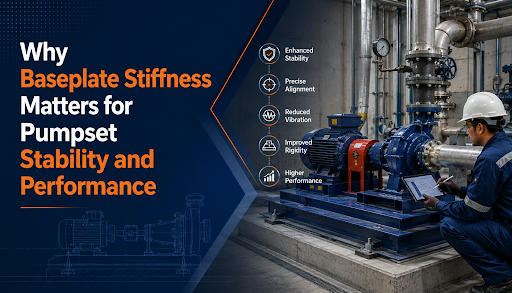
A pumpset is only as stable as the structure supporting it. While attention often goes to pump capacity, efficiency, and motor selection, the baseplate plays an equally important role in keeping the complete assembly stable and properly aligned.
For a water pump supplier, getting this foundation right is essential for reliable operation. Here is why baseplate stiffness deserves attention when designing or selecting an industrial pumpset.
What Does the Baseplate Do?
The baseplate supports the pump, motor, and coupling as one assembly. It provides a common mounting surface and helps maintain the relative position of these components during operation.
A properly designed baseplate distributes operating loads and helps the pumpset remain stable. This is particularly important for industrial applications, where pumps may operate continuously and under demanding conditions. VEMPL offers a range of industrial pumps for applications including industrial water supply, cooling, firefighting, and process requirements.
Why Does Stiffness Matter?
When a baseplate lacks adequate stiffness, it can flex or deform under operating loads. Even small movement can affect the alignment between the pump and motor shafts.
Poor alignment can contribute to increased vibration, which may then place additional stress on the coupling, bearings, seals, and other mechanical components. Over time, this can mean more frequent maintenance, premature component wear, and reduced pumpset reliability.
This is why industrial water pump suppliers in Mumbai and other engineering solution providers must consider the complete pumpset rather than treating the pump as an isolated component.
Foundation and Mounting Matter Too
A stiff baseplate cannot compensate for an inadequate foundation. The foundation must provide sufficient support and remain stable under the operating loads of the pumpset.
Proper mounting, levelling, grouting and secure anchoring help create a stable connection between the equipment and its foundation. The objective is simple: prevent unwanted movement and preserve alignment during operation.
What Influences Baseplate Design?
Several factors influence the design and stiffness required for a baseplate, including:
- Pump and motor size and weight
- Operating speed and power
- Arrangement and dimensions of the pumpset
- Coupling configuration
- Operating loads and forces
- Foundation conditions
- Pipe loads and external forces acting on the pump
The right design therefore depends on the complete system, not just the pump model.
Good Support vs Inadequate Support
A properly designed baseplate provides a rigid, stable platform that helps maintain alignment and control vibration. Inadequate structural support can allow movement, distortion, and vibration to develop during operation.
For a pump supplier near me, this distinction is important when recommending a pumpset for demanding applications. VEMPL’s portfolio includes end suction, split case, multi-stage, vertical turbine, and vertical inline pumps for diverse industrial requirements.
Ultimately, baseplate stability contributes to long-term pumpset reliability. For businesses comparing industrial pump suppliers, evaluating the quality of the complete installation can be just as important as comparing pump specifications.
Looking for a pumpset backed by careful engineering and end-to-end quality? Connect with VEMPL’s experts at +91 8976951701, +91 9819907445 or 022 43117133, or write to marketing@vemc.co.in for assistance with your pumping requirements.
Frequently Asked Questions (FAQs)
1. What is a pumpset baseplate?
It is the structural platform that supports the pump, motor, and associated components as one assembly.
2. How does baseplate stiffness affect vibration?
A sufficiently stiff baseplate helps prevent unwanted movement and preserves pump-motor alignment, reducing vibration.
3. Can poor alignment damage pump components?
Yes. Misalignment can increase loads on couplings, bearings, seals and other mechanical parts, accelerating wear.
4. Is the foundation as important as the baseplate?
Yes. Both need to provide stable support so the pumpset remains properly positioned during operation.
5. Why should baseplate design be considered during pump selection?
Because pumpset performance depends on the complete assembly and installation, not the pump alone.