
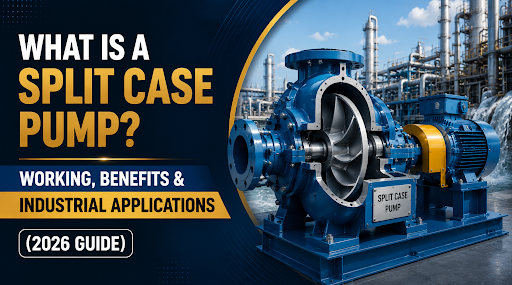
A split case pump is one of the most widely used centrifugal pumps for high-flow water transfer applications across industrial, commercial, infrastructure, and municipal sectors.
Known for its high efficiency, easy maintenance, and reliable performance, the split case pump is commonly used in water supply systems, HVAC applications, firefighting systems, industrial utilities, and large infrastructure projects.
In this 2026 guide, we explain the working principle, major benefits, and industrial applications of a split case pump.
What Is a Split Case Pump?
A split case pump is a type of centrifugal pump where the casing is split horizontally into two separate halves.
This design allows easy access to internal components such as:
- Impeller
- Shaft
- Bearings
- Wear rings
without disturbing the piping connections.
The split case pump is specially designed for:
- High flow rates
- Continuous operation
- Energy-efficient water transfer
- Heavy-duty industrial applications
Because of its robust construction and hydraulic efficiency, the split case pump is widely preferred for critical applications.
How Does a Split Case Pump Work?
The working principle of a split case pump is based on centrifugal force.
Here’s how it works:
- Water enters the pump through the suction nozzle.
- The rotating impeller increases the velocity of the fluid.
- Centrifugal force converts velocity into pressure energy.
- Pressurized water exits through the discharge nozzle.
The horizontally split casing allows balanced hydraulic forces and smooth fluid flow, improving overall efficiency and operational stability.
Main Components of a Split Case Pump
A typical split case pump consists of:
- Pump casing
- Impeller
- Shaft
- Bearings
- Mechanical seals or gland packing
- Suction and discharge nozzles
The casing design makes maintenance faster and easier compared to many other pump types.
Benefits of Split Case Pump
1. High Energy Efficiency
One of the biggest advantages of a split case pump is its excellent hydraulic efficiency.
Benefits include:
- Lower power consumption
- Reduced operating costs
- Better system performance
This makes the split case pump ideal for continuous-duty industrial applications.
2. Easy Maintenance
The horizontally split casing allows maintenance teams to inspect internal components without disconnecting pipework.
This helps:
- Reduce downtime
- Simplify servicing
- Lower maintenance costs
Easy maintenance is one of the main reasons industries prefer the split case pump for critical operations.
3. High Flow Capacity
A split case pump is specifically designed to handle large volumes of water efficiently.
These pumps are commonly used in:
- Municipal water systems
- HVAC circulation
- Firefighting systems
- Industrial water transfer
4. Reliable Continuous Operation
The robust design of a split case pump supports continuous operation in demanding environments.
This makes it suitable for:
- Industrial plants
- Infrastructure projects
- Commercial buildings
- Utility services
5. Long Service Life
With proper maintenance, a split case pump offers:
- Extended operational life
- Reduced wear and tear
- Reliable long-term performance
The durable construction helps minimize unexpected failures.
Industrial Applications of Split Case Pump
1. Municipal Water Supply Systems
A split case pump is widely used for large-scale water distribution and municipal water transfer applications.
Its high flow handling capability makes it ideal for urban infrastructure projects.
2. HVAC Systems
Commercial buildings and industrial facilities use split case pump systems for HVAC water circulation because of their:
- High efficiency
- Stable flow performance
- Continuous operation capability
3. Firefighting Systems
A split case pump is commonly used in firefighting systems due to its:
- High discharge capacity
- Reliable emergency operation
- Strong hydraulic performance
These pumps are widely installed in:
- High-rise buildings
- Industrial plants
- Commercial complexes
4. Industrial Utility Applications
Industries use split case pump systems for:
- Cooling water circulation
- Process water transfer
- Utility water systems
- General industrial services
5. Infrastructure Projects
Large infrastructure developments depend on split case pump systems for:
- Water management
- Pressure boosting
- Utility distribution
- Continuous water circulation
FAQs on Split Case Pump
What is the main advantage of a split case pump?
The main advantage of a split case pump is high efficiency combined with easy maintenance and high flow handling capability.
Where is a split case pump commonly used?
A split case pump is commonly used in:
- Water supply systems
- HVAC applications
- Firefighting systems
- Industrial plants
- Infrastructure projects
Is a split case pump energy efficient?
Yes. Modern split case pump systems are designed for optimized hydraulic efficiency and reduced energy consumption.
Why is maintenance easier in a split case pump?
The horizontally split casing allows easy access to internal components without removing piping connections.
Can a split case pump operate continuously?
Yes. A split case pump is designed for continuous-duty industrial and infrastructure applications.
Conclusion
The split case pump remains one of the most reliable and energy-efficient pumping solutions for industrial, commercial, and infrastructure applications in 2026.
Its ability to handle high flow rates, operate continuously, and simplify maintenance makes it ideal for critical water transfer applications.
Whether for HVAC systems, municipal water supply, firefighting systems, or industrial utilities, investing in the right split case pump can significantly improve operational efficiency and long-term reliability.
Looking for Reliable Split Case Pump Solutions?
Vijay Engineering & Machinery Pvt. Ltd. (VEMPL)
Authorized Channel Partners of Kirloskar Brothers Limited
Providing Advanced Pumping Solutions, Genuine Pump Spares & Engineering Support for Industrial, Commercial & Infrastructure Applications
Email: marketing@vempl.co.in