
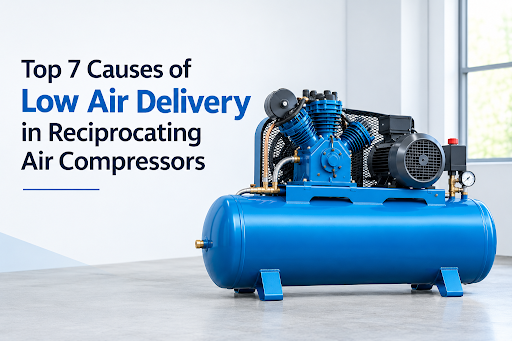
A reciprocating air compressor is designed to deliver a consistent volume of compressed air at the required pressure. When air delivery drops, equipment may take longer to reach operating pressure, consume more energy and struggle to meet process demands.
To troubleshoot the problem effectively, it is important to understand Free Air Delivery (FAD). FAD is the volume of air a compressor delivers, expressed at standard inlet conditions. It reflects the actual output of the compressor rather than its theoretical displacement. A drop in FAD can indicate wear, blockage, leakage or incorrect operating conditions.
Here are seven common causes of low air delivery and how to address them.
1. Damaged or Faulty Valves
Inlet and discharge valves control the movement of air through the cylinder. Worn, broken or carbon-fouled valves can prevent proper sealing, reducing the amount of air compressed.
How to identify: Check for unusual valve noise, abnormal pressure readings or reduced output.
Troubleshooting: Inspect the valve plates, springs and seats. Clean or replace damaged components as required.
2. Worn Piston Rings
Piston rings maintain the seal between the piston and cylinder wall. Worn rings allow compressed air to escape past the piston, reducing compression efficiency.
How to identify: Look for reduced pressure, increased oil consumption or blow-by.
Troubleshooting: Inspect ring condition and cylinder wear. Replace worn piston rings and related components where necessary.
3. Clogged Air Filters
A blocked inlet filter restricts the amount of air entering the cylinder. This reduces the compressor’s effective air intake and can increase the load on the machine.
How to identify: Check the pressure drop across the filter and inspect it for dirt accumulation.
Troubleshooting: Clean or replace the filter according to the manufacturer’s recommendations.
4. Air Leakage
Leaks in pipelines, fittings, valves or compressor connections can reduce the air reaching the point of use, even when the compressor itself is functioning correctly.
How to identify: Listen for hissing sounds, inspect joints and use leak detection equipment where available.
Troubleshooting: Tighten connections and replace damaged hoses, seals or fittings.
5. Incorrect Cylinder Clearance
Excessive clearance between the piston and cylinder head leaves more compressed air trapped inside the cylinder. This reduces the volume of fresh air drawn in during the next cycle.
How to identify: Compare measured clearance with the manufacturer’s specified values.
Troubleshooting: Adjust the clearance or replace components if wear has altered the specified dimensions.
6. Cylinder Wear
Scored or worn cylinder surfaces can prevent the piston rings from sealing effectively. This leads to internal leakage and lower compression.
How to identify: Monitor pressure performance and inspect the cylinder during scheduled maintenance.
Troubleshooting: Measure cylinder dimensions and recondition or replace the cylinder when wear exceeds permissible limits.
7. Incorrect Operating Conditions
Low inlet pressure, excessive ambient temperature, incorrect pressure settings or operation beyond the compressor’s design conditions can affect air delivery.
How to identify: Check inlet pressure, ambient conditions, discharge pressure and operating parameters against specifications.
Troubleshooting: Restore operating conditions to the manufacturer’s recommended range.
Preventive Maintenance for Reliable Air Delivery
Regular maintenance helps prevent gradual loss of FAD. Inspect and clean filters, check valves and connections, monitor pressure and temperature, inspect piston rings and cylinders and conduct periodic leak tests. Maintaining correct lubrication and following the manufacturer’s service intervals can also extend component life.
When low air delivery persists despite routine maintenance, a detailed inspection may be necessary. Significant valve damage, excessive cylinder wear, worn piston rings or repeated pressure loss can indicate the need for servicing or a complete overhaul of the reciprocating air compressor.
Connect with VEMPL for reliable reciprocating air compressor solutions designed to meet your air compression requirements at +91-8976951701, +91-9987099448, 022-43117133, or email marketing@vempl.co.in.
Frequently Asked Questions
Q1. What Is Free Air Delivery in a Compressor?
FAD is the volume of compressed air delivered by a compressor, expressed at specified standard inlet conditions. It provides a practical measure of actual compressor output.
Q2. Why Does a Compressor Deliver Less Air Than Its Rated Capacity?
Restricted air intake, valve problems, piston ring wear, internal leakage, cylinder wear and unsuitable operating conditions can all reduce actual air delivery.
Q3. How Can I Check for Air Leakage?
Inspect pipe joints, fittings, valves and hoses for audible leaks. Ultrasonic leak detection equipment can help locate smaller leaks that may not be easily heard.
Q4. When Does a Compressor Need an Overhaul?
An overhaul may be required when low air delivery continues after routine servicing or when inspections reveal significant wear or damage to valves, piston rings, cylinders or other major components.
Q4. How Can Low Air Delivery Be Prevented?
Follow the recommended maintenance schedule, replace filters on time, monitor operating parameters, check for leaks regularly and inspect critical components before excessive wear affects performance.