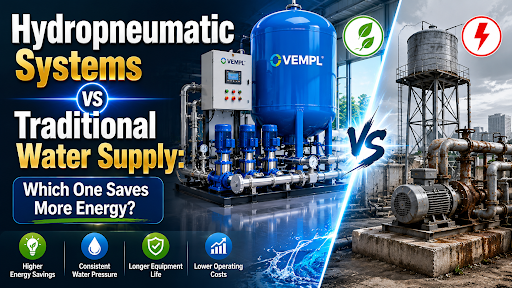
In modern residential, commercial, and industrial buildings, energy-efficient water management has become a top priority. One solution rapidly gaining popularity is the hydropneumatic system for water supply.
Compared to traditional overhead tank-based systems, a hydropneumatic system for water supply offers better pressure management, improved energy efficiency, lower maintenance, and smarter water distribution.
But which system actually saves more energy in the long run?
Let’s compare both systems in detail.
What Is a Hydropneumatic System for Water Supply?
A hydropneumatic system for water supply is an advanced water distribution system that uses pumps, pressure vessels, pressure sensors, and control panels to maintain constant water pressure throughout a building.
Unlike conventional gravity-based systems, a hydropneumatic system for water supply directly supplies pressurized water without relying heavily on overhead tanks.
These systems are widely used in:
- High-rise residential buildings
- Commercial complexes
- Hotels
- Hospitals
- Industrial facilities
- IT parks
What Is a Traditional Water Supply System?
A traditional water supply system generally uses:
- Underground water tanks
- Transfer pumps
- Overhead storage tanks
- Gravity-based distribution
In this setup, pumps continuously transfer water to overhead tanks, and water flows downward using gravity.
While widely used for decades, traditional systems often result in:
- Higher energy usage
- Pressure fluctuations
- Water wastage
- Increased maintenance
Hydropneumatic System for Water Supply vs Traditional Water Supply :
| Parameter | Hydropneumatic System for Water Supply | Traditional Water Supply System |
| Water Pressure | Constant and balanced pressure | Pressure fluctuations common |
| Energy Efficiency | High due to VFD and demand-based operation | Higher energy consumption |
| Pump Operation | Automatic and optimized | Often continuous/manual |
| Water Wastage | Minimal | Higher chances of overflow/leakage |
| Space Requirement | Less rooftop space required | Requires large overhead tanks |
| Maintenance | Lower maintenance | Frequent tank and valve maintenance |
| Automation | Advanced automation possible | Limited automation |
| Suitable for High-Rise Buildings | Highly suitable | Less efficient for tall buildings |
| Operating Cost | Lower long-term operating cost | Higher long-term energy cost |
| User Comfort | Better water pressure experience | Inconsistent water supply possible |
For modern commercial buildings, hospitals, hotels, and residential towers, a hydropneumatic system for water supply offers better operational efficiency, lower electricity consumption, and improved user comfort compared to traditional water supply systems.
FAQs on Hydropneumatic System for Water Supply
What is the main benefit of a hydropneumatic system for water supply?
The biggest advantage is constant water pressure with improved energy efficiency and reduced water wastage.
Is a hydropneumatic system for water supply suitable for high-rise buildings?
Yes. A hydropneumatic system for water supply is ideal for high-rise buildings because it ensures uniform pressure across all floors.
Does a hydropneumatic system reduce electricity bills?
Yes. Since pumps operate based on actual demand and use energy-efficient controls, a hydropneumatic system for water supply can significantly lower energy consumption.
Does a hydropneumatic system require an overhead tank?
In many cases, the dependency on large overhead tanks is greatly reduced or eliminated.
Where are hydropneumatic systems commonly used?
A hydropneumatic system for water supply is commonly used in:
- Residential towers
- Commercial buildings
- Hospitals
- Hotels
- Industrial plants
- Educational institutions
Which System Is Better for Modern Buildings?
For modern infrastructure projects focused on:
- Energy efficiency
- Smart building management
- Space optimization
- Water conservation
- Lower operational costs
A hydropneumatic system for water supply is clearly the preferred choice.
While traditional systems may have lower initial installation costs, hydropneumatic systems provide better long-term savings and operational efficiency.
Conclusion :
As buildings become smarter and more energy-conscious, the demand for efficient water distribution systems continues to grow. A hydropneumatic system for water supply offers significant advantages over traditional gravity-based systems, especially in terms of energy savings, pressure stability, automation, and reduced maintenance.
For residential, commercial, and industrial applications looking to optimize water management and reduce operational costs, investing in a reliable hydropneumatic system for water supply is a smart long-term decision.
Looking for Reliable Hydropneumatic Water Supply Solutions?
Vijay Engineering & Machinery Pvt. Ltd. (VEMPL)
Authorized Channel Partners of Kirloskar Brothers Limited
Providing Efficient Pumping & Water Management Solutions for Residential, Commercial & Industrial Applications
Email: marketing@vempl.co.in